
300-365 · Question #131
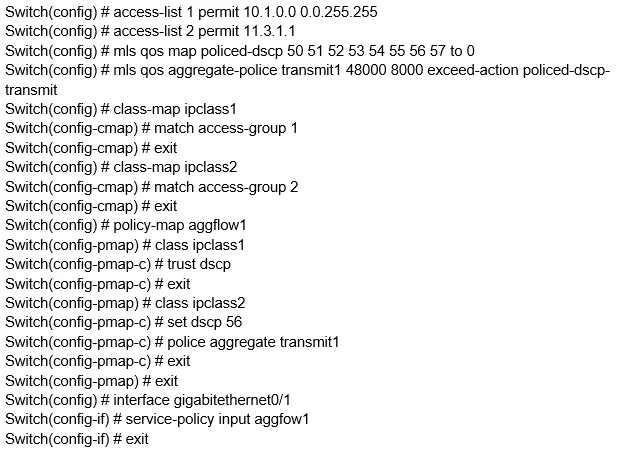
Refer to the exhibit. You have network traffic from host 10.1.1.1 that has an average transmit rate of 64 kbps and is marked with DSCP. Which statement about the effect of the policy is true?
The correct answer is B. The DSCP value in the incoming packets is is trusted. A QoS policy that trusts DSCP preserves the existing DSCP markings in incoming packets rather than overwriting or zeroing them.
Question
Refer to the exhibit. You have network traffic from host 10.1.1.1 that has an average transmit rate of 64 kbps and is marked with DSCP. Which statement about the effect of the policy is true?
Exhibit
Options
- AThe DSCP value in the incoming packets is changed to 51
- BThe DSCP value in the incoming packets is is trusted
- CThe DSCP value in the incoming packets is untrusted and changed to 0
- DThe DSCP value in the incoming packets is changed to 56
How the community answered
(40 responses)- A5% (2)
- B73% (29)
- C15% (6)
- D8% (3)
Why each option
A QoS policy that trusts DSCP preserves the existing DSCP markings in incoming packets rather than overwriting or zeroing them.
A DSCP value of 51 would require an explicit 'set dscp 51' action in the policy-map class; a trust action does not rewrite the DSCP field to any specific numeric value.
When a QoS policy is configured to trust DSCP, the router or switch accepts and preserves the DSCP value already stamped in the incoming packet's IP header. This means no re-marking occurs and the packet is forwarded and queued according to its original DSCP value, which is the expected behavior when a trust boundary is established for a known and trusted source.
Resetting DSCP to 0 (best-effort) is the result of an untrusted or unclassified policy treatment, not a trust configuration - trusting DSCP explicitly preserves the incoming marking.
A DSCP value of 56 (CS7) would require an explicit 'set dscp 56' action in the policy-map class and does not result from configuring a trust state.
Concept tested: QoS DSCP trust boundary and marking behavior
Source: https://www.cisco.com/c/en/us/td/docs/ios-xml/ios/qos_mqc/configuration/xe-17/qos-mqc-xe-17-book/qos-mark.html
Topics
Community Discussion
No community discussion yet for this question.