
300-360 · Question #257
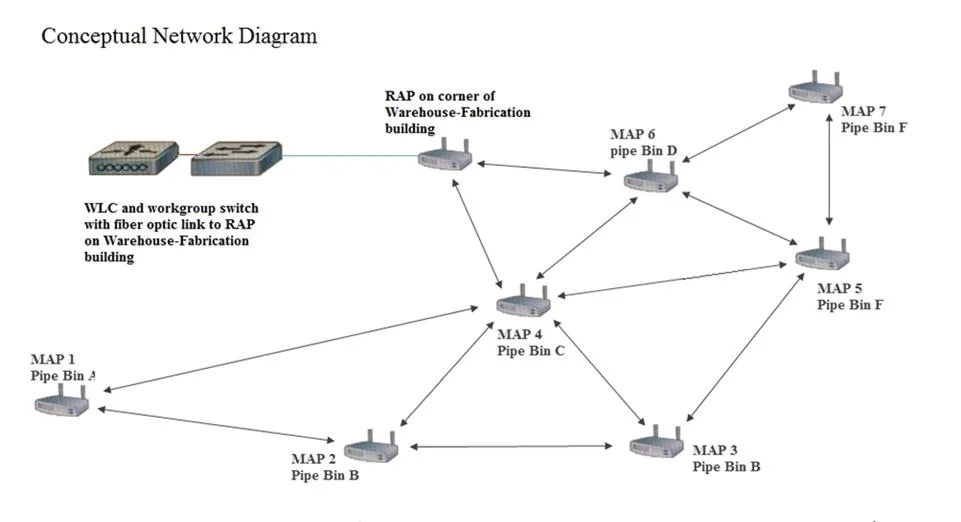
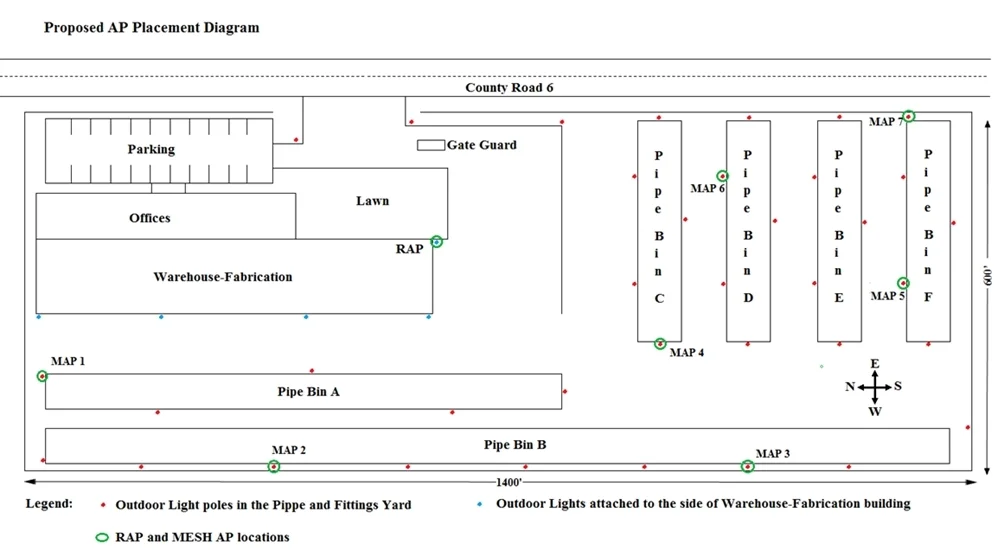
You have been contacted by an existing Cisco wireless networking customer. The Big Oil Service Company wants to expand their Wi-Fi network outside their facility to their Pipe and Fittings Yard. The…
The correct answer is B. There is no direct line-of-sight between the two devices. In outdoor Cisco mesh networking, a reliable backhaul link between a Root Access Point (RAP) and a Mesh Access Point (MAP) requires clear line-of-sight (LOS). Without direct LOS, the signal must travel through or around obstructions (such as large pipes, fittings, storage…
Question
You have been contacted by an existing Cisco wireless networking customer. The Big Oil Service Company wants to expand their Wi-Fi network outside their facility to their Pipe and Fittings Yard. The customer is in the oil field services business and provides consumable products to the oil drilling industry. The customer has been using hand-held scanners on their fleet of order- processing vehicles to ensure that the correct parts are collected for each order. The issue that the customer is experiencing is that the processing of customer orders is taking an excessive amount of time. Each time a new order is received, a paper pull-ticket is physically handed to the operator of an order- processing vehicle. If the specific vehicle cannot pull all the components of a customer order, they must physically hand-off the paper pull-ticket to another order-processing vehicle for completion. After the operator scans the parts to complete the order, they must drive back to the warehouse office to download the order information from the hand-held scanners into the order processing terminals. The current hand- held scanner can process only one order at a time. The company is upgrading to new scanners that operate in the 2.4 GHz spectrum and can process multiple orders simultaneously without any paper forms. The company wants you to validate a design that their internal IT staff has created for the Pipe and Fittings Yard. (See the enclosed Conceptual Network Diagram and a Proposed AP Placement Diagram of the Big Oil Services Company facility.) The Pipe and Fitting Yard has lights for operation at night. The lights are attached to the side of the Warehouse and Fabrication building and are on 40 foot concrete poles out in the yard and all the lights have 110V power. The RAP location is on the side of the Warehouse and Fabrication building below the roof line and just below the exterior light on the side of the building. The RAP will draw power from this light and will have a fiber optic connection back to a switch in the MDF in the office building. All the MAPs will be attached to the light poles in various locations around the Pipe and Fittings Yard. (See enclosed Proposed AP Placement Diagram.) Why is the MAP 1 at the north end of Pipe Bin A unable to connect to the RAP directly?
Exhibits
Options
- AOver 60% of the Fresnel zone between the two devices is blocked.
- BThere is no direct line-of-sight between the two devices.
- CThe EASE is 48678 for the RAP.
- DThe delay is too great (100 ms) from the RAP.
How the community answered
(46 responses)- A13% (6)
- B54% (25)
- C7% (3)
- D26% (12)
Explanation
In outdoor Cisco mesh networking, a reliable backhaul link between a Root Access Point (RAP) and a Mesh Access Point (MAP) requires clear line-of-sight (LOS). Without direct LOS, the signal must travel through or around obstructions (such as large pipes, fittings, storage racks, or equipment in a yard), causing severe signal attenuation and unreliable backhaul. While Fresnel zone obstruction over 60% (option A) would also degrade a link, the absence of any direct LOS is the definitive disqualifier - the link simply cannot sustain a reliable mesh backhaul connection. Option C (EASE value) and option D (100 ms delay) are not primary disqualifying factors for a mesh link in this scenario; LOS is the foundational requirement.
Topics
Community Discussion
No community discussion yet for this question.