
300-320 · Question #723
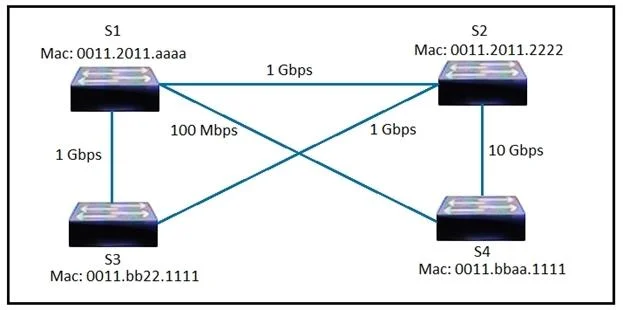
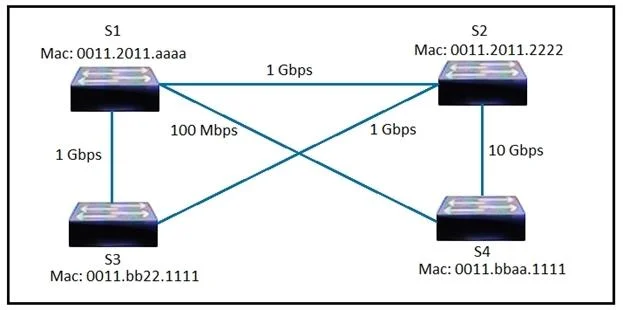
Refer to the exhibit. The network uses STP. All switches use the default priority. Which switch will be the root bridge?
The correct answer is B. S2. When all switches use the default STP bridge priority (32768), the root bridge is elected based on the lowest Bridge ID. Since all priorities are equal, the tiebreaker is the lowest MAC address. The exhibit (not shown here) displays the MAC addresses of the four switches. S2…
Question
Refer to the exhibit. The network uses STP. All switches use the default priority. Which switch will be the root bridge?
Exhibits
Options
- AS1
- BS2
- CS3
- DS4
How the community answered
(43 responses)- A2% (1)
- B88% (38)
- C5% (2)
- D5% (2)
Explanation
When all switches use the default STP bridge priority (32768), the root bridge is elected based on the lowest Bridge ID. Since all priorities are equal, the tiebreaker is the lowest MAC address. The exhibit (not shown here) displays the MAC addresses of the four switches. S2 has the lowest MAC address among S1, S2, S3, and S4, so it wins the root bridge election. This is a fundamental STP concept: Bridge ID = Priority (16-bit) + MAC Address (48-bit). Equal priorities mean the switch with the numerically smallest MAC address becomes the root bridge and all ports on the root bridge are designated forwarding ports.
Topics
Community Discussion
No community discussion yet for this question.