nerdexam
LPI

300-300 · Question #75

Which of the following statements are true regarding a Samba server whose configuration contains the following section? (Choose three.)

The correct answer is A. The description of the virtual home directory share of any user is set to Home Directories. B. The option browseable disables the virtual home directory share named after the connected C. The virtual home directory share only appears when the user's home directory exists in the file. Options A, B, and C accurately describe the behavior of Samba's special [homes] section, which acts as a template for virtual, per-user home shares. The comment = Home Directories value (A) becomes the description for every virtual share created from this template. Setting…

300.4 File Sharing

Question

Which of the following statements are true regarding a Samba server whose configuration contains the following section? (Choose three.)

Exhibit
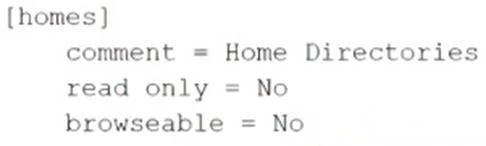
300-300 question #75 exhibit

Options

  • AThe description of the virtual home directory share of any user is set to Home Directories.
  • BThe option browseable disables the virtual home directory share named after the connected
  • CThe virtual home directory share only appears when the user's home directory exists in the file
  • DAll users can access the share homes, which is mapped to the home directory of the connected
  • EWrite access is permitted on the virtual share named by the user's name and is rejected on the

How the community answered

(54 responses)
  • A
    89% (48)
  • D
    7% (4)
  • E
    4% (2)

Explanation

Options A, B, and C accurately describe the behavior of Samba's special [homes] section, which acts as a template for virtual, per-user home shares. The comment = Home Directories value (A) becomes the description for every virtual share created from this template. Setting browseable = no (B) hides those user-named virtual shares (e.g., [alice]) from network browse lists - users must connect by explicitly typing the share name. Samba also validates whether the user's home directory physically exists on the filesystem before presenting the share (C), so no directory means no share.

Why D is wrong: The valid users = %S directive (a common default in [homes]) restricts each virtual share to only the user whose name matches the share - not all users. Each person sees only their own home, not a shared location.

Why E is wrong: Write permissions from the [homes] section apply uniformly to all virtual shares derived from it. There is no mechanism that grants write access on the user-named virtual share while blocking it on the [homes] entry itself - they are the same template.

Memory tip: Think of [homes] as a rubber stamp - it stamps its comment, browseable, and writable settings onto every user's virtual share. A, B, and C describe the stamp's properties; D and E incorrectly imply exceptions that the stamp doesn't support.

Topics

#Samba homes share#browseable option#virtual home directories#share parameters

Community Discussion

No community discussion yet for this question.

Full 300-300 Practice