
300-215 · Question #30
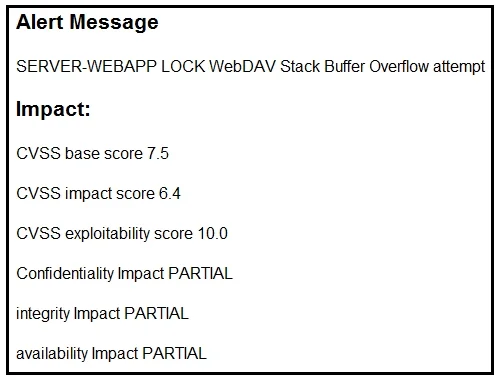
Refer to the exhibit. After a cyber attack, an engineer is analyzing an alert that was missed on the intrusion detection system. The attack exploited a vulnerability in a business critical…
The correct answer is C. address space randomization E. data execution prevention. The alert indicates a WebDAV Stack Buffer Overflow, which is a memory corruption attack targeting the stack, a common vector for remote code execution or denial-of-service (DoS). To mitigate such exploits, two effective system-hardening techniques are: Address Space Layout…
Question
Refer to the exhibit. After a cyber attack, an engineer is analyzing an alert that was missed on the intrusion detection system. The attack exploited a vulnerability in a business critical, web-based application and violated its availability. Which two migration techniques should the engineer recommend? (Choose two.)
Exhibit
Options
- Aencapsulation
- BNOP sled technique
- Caddress space randomization
- Dheap-based security
- Edata execution prevention
How the community answered
(27 responses)- A4% (1)
- B7% (2)
- C81% (22)
- D7% (2)
Explanation
The alert indicates a WebDAV Stack Buffer Overflow, which is a memory corruption attack targeting the stack, a common vector for remote code execution or denial-of-service (DoS). To mitigate such exploits, two effective system-hardening techniques are: Address Space Layout Randomization (ASLR): Randomizes memory addresses used by system and application processes, making it difficult for attackers to predict where their malicious code will be executed. Data Execution Prevention (DEP): Prevents execution of code from non-executable memory regions such as the stack, thus stopping buffer overflow attacks from successfully executing payloads. Both are well-established protections against stack-based buffer overflow attacks and are strongly recommended in the Cisco CyberOps Associate guide and general security best practices.
Topics
Community Discussion
No community discussion yet for this question.