
300-170 · Question #121
Refer to the exhibit. Which configuration must you use for VMware load balancing when implementing VMM integration between the Cisco UCS-B Blade Server?
The correct answer is A. route based on originating port ID. When integrating VMware with Cisco UCS-B Blade Servers, the recommended vSphere Distributed Switch load balancing policy is 'route based on originating port ID'.
Question
Refer to the exhibit. Which configuration must you use for VMware load balancing when implementing VMM integration between the Cisco UCS-B Blade Server?
Exhibit
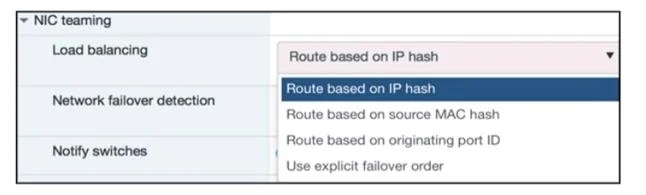
Options
- Aroute based on originating port ID
- Broute based on source MAC hash
- Croute based on IP hash
- Dexplicit failover order
How the community answered
(33 responses)- A88% (29)
- B3% (1)
- C6% (2)
- D3% (1)
Why each option
When integrating VMware with Cisco UCS-B Blade Servers, the recommended vSphere Distributed Switch load balancing policy is 'route based on originating port ID'.
The 'route based on originating port ID' load balancing policy for a vSphere Distributed Switch (vDS) ensures that traffic from a specific virtual machine's vNIC consistently uses the same physical uplink. This method is simple, reliable, and avoids potential issues like MAC address flapping on the upstream physical switches (like Cisco UCS or ACI) that are not explicitly configured for LACP or IP hashing from the server side.
'Route based on source MAC hash' is a valid load balancing option, but 'originating port ID' is often preferred for its simplicity and deterministic behavior in UCS/ACI environments where the physical uplinks may not be specifically configured for other hashing methods.
'Route based on IP hash' requires LACP (Link Aggregation Control Protocol) to be configured and negotiated on both the vDS and the physical switch (Cisco UCS fabric interconnects or ACI leaf ports). Without LACP on both sides, this policy will cause network connectivity issues.
'Explicit failover order' is a failover policy, which defines the sequence of uplinks to use if the primary link fails, rather than a load balancing policy for distributing traffic across multiple active uplinks simultaneously.
Concept tested: VMware vDS load balancing
Source: https://docs.vmware.com/en/VMware-vSphere/7.0/com.vmware.vsphere.networking.doc/GUID-C3F4655F-912A-4B69-906C-773C74C563D4.html
Topics
Community Discussion
No community discussion yet for this question.