
300-070 · Question #56
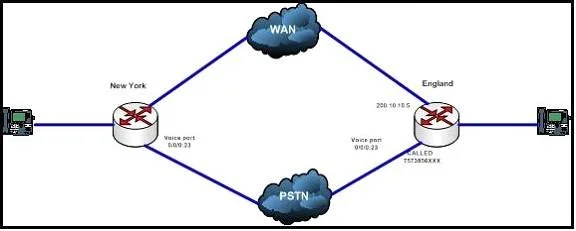
Refer to the exhibit and configuration output. What are the two main ways from New York to call Extension 6001 in England? (Choose two.) sh run | s Dial-peer dial-peer voice 2 voip…
The correct answer is A. The first way is WAN. D. The second way is PSTN. The configuration shows two dial-peers matching destination-pattern '6...': Dial-peer 2 is a VoIP peer (WAN path) with preference 0 (lowest number = highest priority), targeting IP 200.10.10.5. Dial-peer 3 is a POTS peer (PSTN path) with preference 1 (lower priority/backup)…
Question
Refer to the exhibit and configuration output. What are the two main ways from New York to call Extension 6001 in England? (Choose two.) sh run | s Dial-peer dial-peer voice 2 voip destination-pattern 6... preference 0 session-target ipv4: 200.10.10.5 dtmf-relay sip-notify dial-peer voice 3 pots destination-pattern 6... preference 1 port 0/0/0:23 prefix 757385 dtmf-relay sip-notify
Exhibit
Options
- AThe first way is WAN.
- BThe first way is PSTN.
- CThe second way is WAN.
- DThe second way is PSTN.
How the community answered
(54 responses)- A72% (39)
- B11% (6)
- C17% (9)
Explanation
The configuration shows two dial-peers matching destination-pattern '6...': Dial-peer 2 is a VoIP peer (WAN path) with preference 0 (lowest number = highest priority), targeting IP 200.10.10.5. Dial-peer 3 is a POTS peer (PSTN path) with preference 1 (lower priority/backup). Since preference 0 is tried first, the primary (first) path is WAN (answer A). Since preference 1 is used as the fallback, the secondary (second) path is PSTN (answer D). This is a classic primary WAN / backup PSTN dial-peer design.
Topics
Community Discussion
No community discussion yet for this question.