
300-070 · Question #407
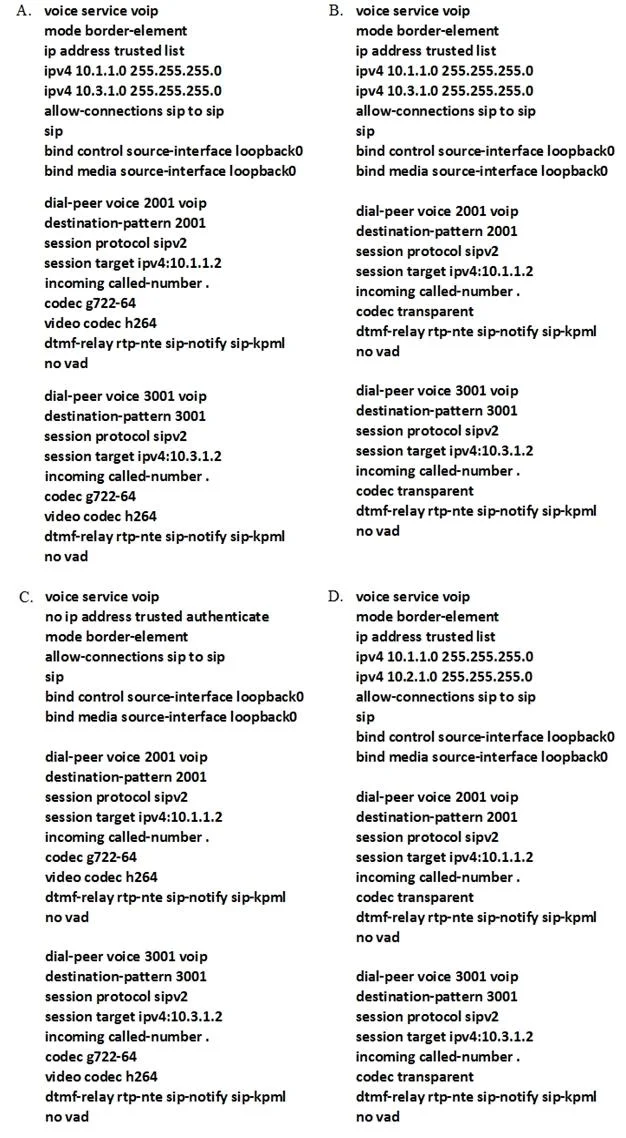
Refer to the exhibit. An engineer is configuring the Cisco Unified Border Element and wants to make sure that: - When TEL1 calls TEL2, the call successfully connects using G722(audio)/H264(video)…
The correct answer is B. Option B. To allow G.722 and H.264 to negotiate end-to-end without CUBE interfering in codec selection, CUBE must be configured for codec passthrough (transparent codec negotiation).
Question
Refer to the exhibit. An engineer is configuring the Cisco Unified Border Element and wants to make sure that:
- When TEL1 calls TEL2, the call successfully connects using
G722(audio)/H264(video).
- The Cisco Unified Border Element should not participate in the codec
selection. Which Cisco Unified Border Element configuration achieves this request?
Exhibits

Options
- AOption A
- BOption B
- COption C
- DOption D
How the community answered
(26 responses)- A19% (5)
- B69% (18)
- C8% (2)
- D4% (1)
Why each option
To allow G.722 and H.264 to negotiate end-to-end without CUBE interfering in codec selection, CUBE must be configured for codec passthrough (transparent codec negotiation).
Option A applies a codec list or media configuration that causes CUBE to actively filter or restrict codecs during negotiation, making CUBE a participant in codec selection rather than a transparent pass-through device.
Option B applies a voice class codec configuration that enables passthrough or transparent mode, instructing CUBE not to insert itself into the SDP offer/answer exchange. This allows the two endpoints to independently agree on G.722 for audio and H.264 for video without CUBE filtering or modifying the codec list, satisfying both the connectivity requirement and the non-participation requirement.
Option C likely enforces a specific codec profile on the CUBE dial peers that would prevent G.722 or H.264 from being passed transparently, because CUBE would apply its own codec constraints to the call legs.
Option D does not include the passthrough or transparent codec configuration, meaning CUBE would still evaluate and potentially alter the codec negotiation between the two endpoints.
Concept tested: CUBE transparent codec passthrough configuration
Source: https://www.cisco.com/c/en/us/td/docs/ios-xml/ios/voice/cube/configuration/cube-book/voi-cube-codec-negotiate.html
Topics
Community Discussion
No community discussion yet for this question.