
300-070 · Question #382
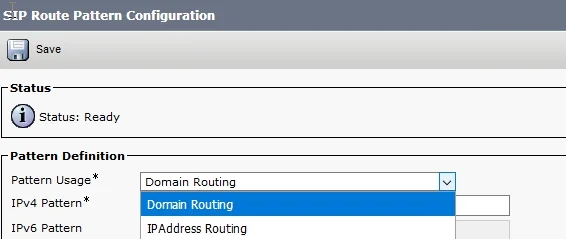
When configuring a SIP route pattern, which two provide the basis for routing? (Choose two)
The correct answer is A. Domain name C. IP address. SIP route patterns in CUCM use domain names and IP addresses as the two bases for routing, enabling both URI-based and topology-based SIP call routing.
Question
When configuring a SIP route pattern, which two provide the basis for routing? (Choose two)
Exhibit
Options
- ADomain name
- BMAC address
- CIP address
- DDirectory number
- EE.164 number
How the community answered
(32 responses)- A94% (30)
- B3% (1)
- E3% (1)
Why each option
SIP route patterns in CUCM use domain names and IP addresses as the two bases for routing, enabling both URI-based and topology-based SIP call routing.
Domain names allow CUCM to match the domain portion of a SIP URI and route calls to the appropriate SIP trunk or endpoint, supporting URI dialing such as [email protected] without requiring a static IP.
MAC addresses identify physical devices during registration in CUCM and are not used as a matching or routing basis in SIP route pattern configuration.
IP addresses allow CUCM to route SIP calls directly to a specific trunk or endpoint identified by its network address, providing a topology-based routing method that does not rely on DNS resolution or URI matching.
Directory numbers are internal CUCM identifiers assigned to endpoints for call routing within the cluster and are not a valid routing basis for SIP route patterns.
E.164 numbers are digit strings used in traditional PSTN route patterns for digit matching but are not one of the two routing bases specific to SIP route pattern configuration.
Concept tested: SIP route pattern routing basis - domain and IP
Source: https://www.cisco.com/c/en/us/td/docs/voice_ip_comm/cucm/admin/12_5_1/systemConfig/cucm_b_system-configuration-guide-1251/cucm_b_system-configuration-guide-1251_chapter_0101101.html
Topics
Community Discussion
No community discussion yet for this question.