
300-070 · Question #277
According to the DiffServ architecture RFC 2475, which two major components are necessary to deliver end to-end QoS? (Choose two)
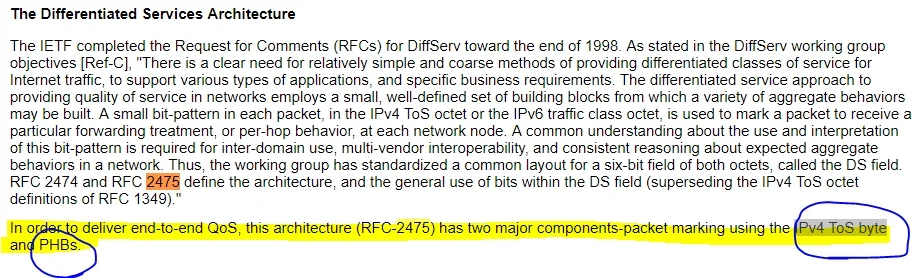
The correct answer is C. ToS or IP precedence with 3 bits D. PHB. RFC 2475 defines the DiffServ architecture around two fundamental components: (1) Packet marking using the IP ToS byte (which includes the 3-bit IP Precedence field that DiffServ builds upon - later expanded to 6-bit DSCP), used to classify and mark traffic at boundaries; and…
Question
According to the DiffServ architecture RFC 2475, which two major components are necessary to deliver end to-end QoS? (Choose two)
Exhibit
Options
- ALayer 2 transport QoS mechanisms such as FRF.12
- Bpacket marking with 6 bits to classify packets
- CToS or IP precedence with 3 bits
- DPHB
- ERSVP
How the community answered
(40 responses)- A3% (1)
- B3% (1)
- C90% (36)
- E5% (2)
Explanation
RFC 2475 defines the DiffServ architecture around two fundamental components: (1) Packet marking using the IP ToS byte (which includes the 3-bit IP Precedence field that DiffServ builds upon - later expanded to 6-bit DSCP), used to classify and mark traffic at boundaries; and (2) Per-Hop Behaviors (PHBs), which define the forwarding treatment each router applies to packets based on their marking. RSVP is associated with IntServ (RFC 2210), not DiffServ. FRF.12 is a Layer 2 fragmentation mechanism, not a DiffServ component. PHBs are what make DiffServ scalable - no per-flow state is maintained in the core.
Topics
Community Discussion
No community discussion yet for this question.