
2V0-622D · Question #86
An administrator has noticed that virtual machine VM2 in the vApp shown in the Exhibit is demonstrating poor performance. Which three changes, if performed separately, would improve the performance…
The correct answer is A. Remove the CPU limit on the vApp. D. Power off virtual machine VM1. E. Increase the CPU reservation on virtual machine VM2. A CPU limit on a vApp creates an aggregate ceiling on all VMs inside it, and VM2's performance improves by removing that ceiling, eliminating VM1 as a competing consumer, or guaranteeing VM2 a minimum entitlement.
Question
An administrator has noticed that virtual machine VM2 in the vApp shown in the Exhibit is demonstrating poor performance. Which three changes, if performed separately, would improve the performance of VM2? (Choose three.)
Exhibit
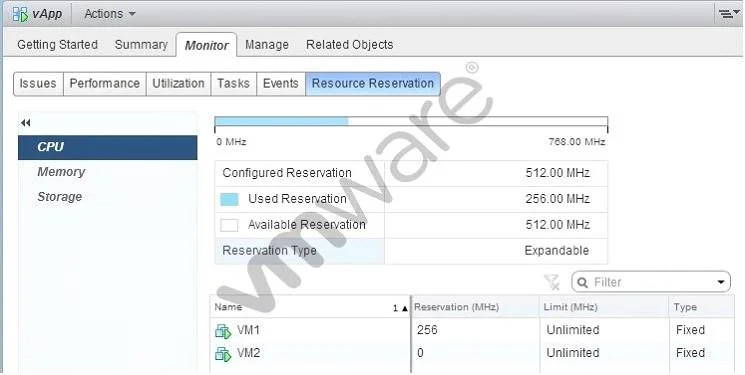
Options
- ARemove the CPU limit on the vApp.
- BRemove the CPU limit on the resource pool.
- CIncrease the CPU reservation on virtual machine VM1.
- DPower off virtual machine VM1.
- EIncrease the CPU reservation on virtual machine VM2.
How the community answered
(34 responses)- A68% (23)
- B12% (4)
- C21% (7)
Why each option
A CPU limit on a vApp creates an aggregate ceiling on all VMs inside it, and VM2's performance improves by removing that ceiling, eliminating VM1 as a competing consumer, or guaranteeing VM2 a minimum entitlement.
Removing the CPU limit on the vApp eliminates the container-level cap that restricts combined CPU access for all VMs inside it, allowing VM2 to consume cycles that were previously blocked by the aggregate limit.
The exhibit places the binding constraint at the vApp CPU limit, not at a separate parent resource pool limit, so removing a resource pool limit above the vApp would not change the CPU available to VM2.
Increasing VM1's CPU reservation raises the minimum CPU that must be held for VM1, which reduces the uncommitted pool available to VM2 and would worsen VM2's performance.
Powering off VM1 removes it as a CPU consumer within the vApp, freeing cycles inside the existing limit so VM2 can use a larger portion of the available allocation without any policy change.
Increasing VM2's CPU reservation establishes a guaranteed minimum entitlement for it, ensuring the hypervisor schedules those cycles for VM2 even under contention from VM1 or the vApp limit.
Concept tested: vApp CPU limits, reservations, and inter-VM resource contention
Source: https://docs.vmware.com/en/VMware-vSphere/7.0/com.vmware.vsphere.resmgmt.doc/GUID-E025F5EB-5C78-4A47-8F00-3D5893FDA4B9.html
Topics
Community Discussion
No community discussion yet for this question.