
2V0-622D · Question #61
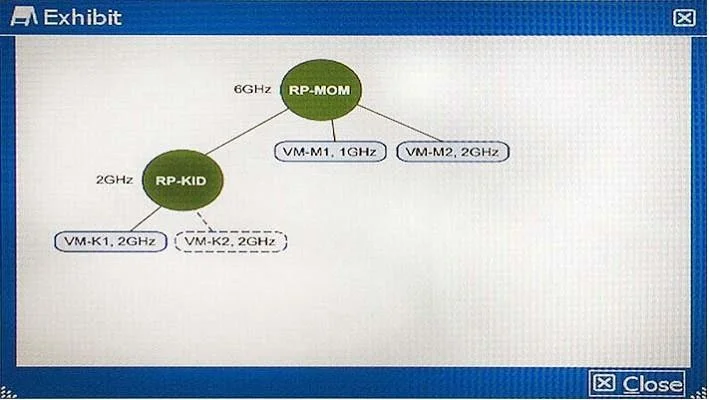
The administrator wants to power on VM-K2, which has a 2GHz CPU reservation. VM-M1, VM- M2, and VM-K1 are all powered on. VM-K2 is not powered on. The exhibit shows the parent and child resource…
The correct answer is A. VM-K2 will be unable to power on because there are insufficient resources. Expandable reservation allows a child pool to borrow from its parent, but if the parent pool has no unreserved capacity left, the VM still cannot power on regardless of that setting.
Question
The administrator wants to power on VM-K2, which has a 2GHz CPU reservation. VM-M1, VM- M2, and VM-K1 are all powered on. VM-K2 is not powered on. The exhibit shows the parent and child resource reservations. If Resource Pool RP-KID is configured with an expandable reservation, which statement is true?
Exhibit
Options
- AVM-K2 will be unable to power on because there are insufficient resources.
- BVM-K2 will be able to power on since resource pool RP-KID has 2GHz available.
- CVM-K2 will be unable to power on because only 2GHz are reserved for RP-KID.
- DVM-K2 will receive resource priority and will be able to power on this scenario.
How the community answered
(30 responses)- A60% (18)
- B10% (3)
- C23% (7)
- D7% (2)
Why each option
Expandable reservation allows a child pool to borrow from its parent, but if the parent pool has no unreserved capacity left, the VM still cannot power on regardless of that setting.
Even with RP-KID configured as expandable, the feature only works when the parent resource pool has unreserved headroom to lend. In this scenario the parent pool's resources are fully committed by the running VMs (VM-M1, VM-M2, and VM-K1), leaving no capacity to satisfy VM-K2's 2GHz CPU reservation, so the power-on admission control check fails.
Having 2GHz reserved for RP-KID does not mean 2GHz is currently free - VM-K1 is already powered on and consuming RP-KID's reserved allocation, leaving insufficient room for VM-K2.
This ignores the expandable reservation feature entirely; expandable reservation is specifically designed to let RP-KID exceed its own stated reservation by borrowing from the parent, so the reservation ceiling alone is not the blocking condition.
Resource pools provide no priority-based power-on override that bypasses admission control; a VM cannot power on if its required CPU reservation cannot be satisfied anywhere in the pool hierarchy.
Concept tested: VMware resource pool expandable reservation and admission control
Source: https://docs.vmware.com/en/VMware-vSphere/7.0/com.vmware.vsphere.resmgmt.doc/GUID-A9B5BB5A-02E4-4D0E-A90A-6A0E2B285F18.html
Topics
Community Discussion
No community discussion yet for this question.