
2V0-622 · Question #95
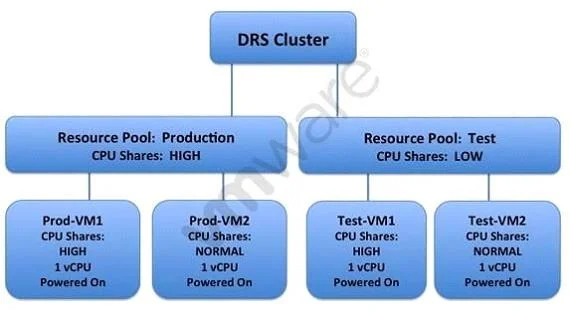
Refer to the Exhibit. An administrator has created the DRS cluster shown in the Exhibit. Based on the exhibit, which statement is true?
The correct answer is A. Under CPU contention, Prod-VM1 receives four times the CPU resources than Test-VM1. CPU shares in vSphere define proportional entitlements under contention; a VM with four times the shares receives four times the CPU of a competing VM.
Question
Refer to the Exhibit. An administrator has created the DRS cluster shown in the Exhibit. Based on the exhibit, which statement is true?
Exhibit
Options
- AUnder CPU contention, Prod-VM1 receives four times the CPU resources than Test-VM1.
- BThe Prod-VM1 will always have more CPU resources than all other virtual machines.
- CThe Test-VM2 will always have less CPU resources than all other virtual machines.
- DUnder CPU contention, Test-VM1 will receive 25% of the total CPU resources.
How the community answered
(33 responses)- A70% (23)
- B15% (5)
- C9% (3)
- D6% (2)
Why each option
CPU shares in vSphere define proportional entitlements under contention; a VM with four times the shares receives four times the CPU of a competing VM.
The exhibit shows Prod-VM1 is configured with four times the CPU shares of Test-VM1, so when both VMs compete for CPU, vSphere allocates CPU proportionally based on each VM's share weight. This results in Prod-VM1 receiving exactly four times the CPU resources of Test-VM1 during contention.
CPU shares only determine relative allocation under contention and do not guarantee a VM will always have more resources; during low utilization, all VMs can receive their full requested CPU regardless of share values.
Share-based allocation is relative and proportional to competing VMs - it does not guarantee Test-VM2 will always have fewer resources than every other VM under all load conditions.
CPU shares produce proportional allocation relative to all competing VMs, not a fixed percentage; the actual percentage a VM receives changes as other VMs are powered on or off.
Concept tested: vSphere CPU shares and proportional resource allocation under contention
Source: https://docs.vmware.com/en/VMware-vSphere/7.0/com.vmware.vsphere.resmgmt.doc/GUID-6C0A7462-5D60-4F37-AF5D-ADE78E1C9C14.html
Topics
Community Discussion
No community discussion yet for this question.