
2V0-622 · Question #203
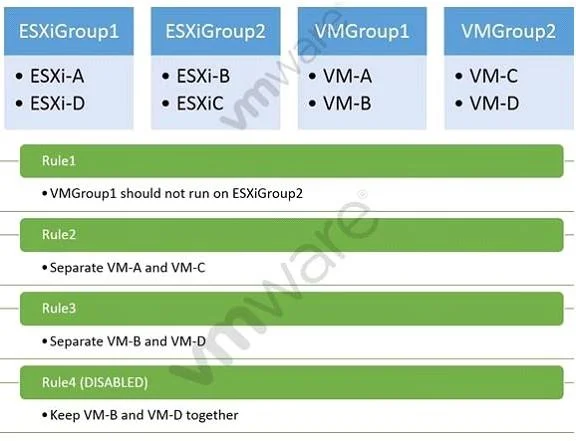
Refer to the Exhibit. An administrator has configured Distributed Resource Scheduler (DRS) groups and Affinity Rules as shown in the Exhibit. Based on the exhibit, which two statements are true?…
The correct answer is B. A new conflicting affinity rule will be disabled by default. D. The administrator must disable Rule3 in order to enable Rule4. In vSphere DRS, a newly created affinity rule that conflicts with an existing rule is disabled by default, and the conflicting existing rule must be disabled before the new rule can be enabled.
Question
Refer to the Exhibit. An administrator has configured Distributed Resource Scheduler (DRS) groups and Affinity Rules as shown in the Exhibit. Based on the exhibit, which two statements are true? (Choose two.)
Exhibit
Options
- AIf ESXi-A and ESXi-D failed, VM-A and VM-B would not failover.
- BA new conflicting affinity rule will be disabled by default.
- CVM-B and VM-D can run on the same hosts.
- DThe administrator must disable Rule3 in order to enable Rule4.
How the community answered
(29 responses)- A28% (8)
- B62% (18)
- C10% (3)
Why each option
In vSphere DRS, a newly created affinity rule that conflicts with an existing rule is disabled by default, and the conflicting existing rule must be disabled before the new rule can be enabled.
If ESXi-A and ESXi-D failed, vSphere HA would still attempt to restart VM-A and VM-B on the remaining available hosts in the cluster, so a complete failover failure would only occur if no hosts had sufficient resources to accommodate the VMs.
When a newly created DRS affinity rule conflicts with an existing active rule, vSphere automatically disables the new rule by default and generates an event to notify the administrator. The new rule remains in a disabled state until the conflict is resolved.
Based on standard DRS rule behavior, VM-VM anti-affinity rules would prevent VM-B and VM-D from running on the same host if such a rule were configured in the exhibit; without a specific anti-affinity rule between them, they could potentially share a host.
Because Rule3 and Rule4 impose contradictory placement constraints, vSphere DRS cannot enforce both simultaneously; the administrator must disable Rule3 first before Rule4 can be enabled and enforced by the DRS engine.
Concept tested: DRS affinity rule conflict detection and resolution workflow
Source: https://docs.vmware.com/en/VMware-vSphere/8.0/vsphere-resource-management/GUID-2FB90EF5-7733-4095-8B66-F10D6C57B820.html
Topics
Community Discussion
No community discussion yet for this question.