
2V0-622 · Question #182
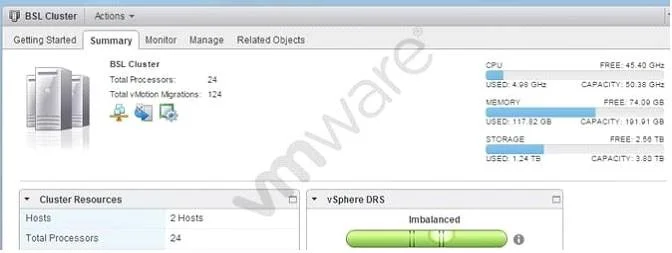
Refer to the Exhibit. An administrator is reviewing a vSphere Distributed Resource Scheduler (DRS) enabled Cluster and observes unexpected behavior as shown in the Exhibit. What are three potential…
The correct answer is A. A local device is mounted to one or more virtual machines. B. DRS rules prevent virtual machines from being moved. C. vMotion is not configured and enabled. A DRS-enabled cluster may show imbalance when VMs cannot be migrated due to local device attachments, DRS rule constraints, or vMotion being unconfigured.
Question
Refer to the Exhibit. An administrator is reviewing a vSphere Distributed Resource Scheduler (DRS) enabled Cluster and observes unexpected behavior as shown in the Exhibit. What are three potential causes of the cluster imbalance? (Choose three.)
Exhibit
Options
- AA local device is mounted to one or more virtual machines.
- BDRS rules prevent virtual machines from being moved.
- CvMotion is not configured and enabled.
- DThere are insufficient cluster resources to perform the migration.
- EDRS has been configured for a conservative migration threshold.
How the community answered
(19 responses)- A68% (13)
- D21% (4)
- E11% (2)
Why each option
A DRS-enabled cluster may show imbalance when VMs cannot be migrated due to local device attachments, DRS rule constraints, or vMotion being unconfigured.
A local device (such as a USB device or local CD-ROM ISO) mounted to a VM prevents vMotion from migrating that VM, causing it to remain pinned to its host and contributing to imbalance.
DRS affinity or anti-affinity rules can explicitly prevent VMs from being moved to other hosts, leaving DRS unable to rebalance even when resources are uneven.
DRS relies entirely on vMotion to execute live migrations; if vMotion is not configured or enabled on the hosts, DRS cannot move any VMs regardless of cluster imbalance.
Insufficient cluster resources would prevent migrations but would typically surface as a capacity alert rather than a DRS imbalance, and DRS would still attempt to rebalance by making recommendations.
A conservative migration threshold reduces the number of DRS recommendations and migrations but does not directly cause a cluster imbalance - it only affects how aggressively DRS acts on imbalances.
Concept tested: vSphere DRS migration constraints and prerequisites
Source: https://docs.vmware.com/en/VMware-vSphere/7.0/com.vmware.vsphere.resmgmt.doc/GUID-517C5B4A-FCDF-4C43-A3E1-9E4A26E03868.html
Topics
Community Discussion
No community discussion yet for this question.