
2V0-621D · Question #254
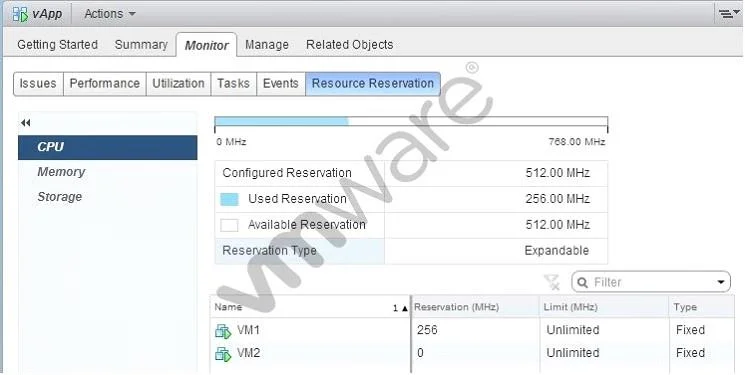
An administrator has noticed that virtual machine VM2 in the vApp shown in the Exhibit is demonstrating poor performance. Which three changes, if performed separately, would improve the performance…
The correct answer is A. Remove the CPU limit on the vApp. D. Power off virtual machine VM1. E. Increase the CPU reservation on virtual machine VM2. To improve a virtual machine's CPU performance, an administrator can remove CPU limits on its parent resource containers, free up resources by powering off other demanding VMs, or directly increase the VM's own CPU reservation.
Question
An administrator has noticed that virtual machine VM2 in the vApp shown in the Exhibit is demonstrating poor performance. Which three changes, if performed separately, would improve the performance of VM2? (Choose three.)
Exhibit
Options
- ARemove the CPU limit on the vApp.
- BRemove the CPU limit on the resource pool.
- CIncrease the CPU reservation on virtual machine VM1.
- DPower off virtual machine VM1.
- EIncrease the CPU reservation on virtual machine VM2.
How the community answered
(33 responses)- A64% (21)
- B12% (4)
- C24% (8)
Why each option
To improve a virtual machine's CPU performance, an administrator can remove CPU limits on its parent resource containers, free up resources by powering off other demanding VMs, or directly increase the VM's own CPU reservation.
If the vApp containing VM2 has a CPU limit, it restricts the total CPU resources available to all virtual machines within it, including VM2. Removing this limit allows the vApp and its virtual machines to utilize more CPU from the underlying host, thereby improving VM2's performance.
Removing the CPU limit on the resource pool would only help if the resource pool's limit was the effective bottleneck; if the vApp itself has a lower, more restrictive limit, removing the resource pool limit would not directly alleviate the constraint on VM2.
Increasing the CPU reservation for VM1 would guarantee more CPU resources to VM1, which would reduce the available CPU for other virtual machines, including VM2. This action would likely worsen VM2's performance, not improve it.
Powering off VM1 releases the CPU resources that VM1 was consuming or reserving, making them available to other virtual machines in the vApp or host. This increase in available CPU resources can significantly improve the performance of VM2, especially if VM1 was a resource-intensive VM.
Increasing the CPU reservation for VM2 guarantees a larger minimum amount of CPU resources to VM2. If VM2 is experiencing poor performance due to CPU contention, this direct increase in guaranteed resources ensures it receives more CPU cycles, leading to improved performance.
Concept tested: vSphere resource pools, vApp limits, reservations, and VM performance
Source: https://docs.vmware.com/en/VMware-vSphere/7.0/com.vmware.vsphere.resmgmt.doc/GUID-D96F491E-E7AC-452B-809A-8E09028935D2.html
Topics
Community Discussion
No community discussion yet for this question.