
2V0-621 · Question #46
Refer to the Exhibit. An administrator is adding an Active Directory over LDAP Identity Source for vCenter Single Sign-On, as indicated in the Exhibit. What is the correct value to configure for the…
The correct answer is A. The domain's NetBIOS name. The Domain alias field in vCenter SSO for an Active Directory over LDAP identity source must be set to the domain's NetBIOS name, which allows users to authenticate using the short DOMAIN\username format.
Question
Refer to the Exhibit. An administrator is adding an Active Directory over LDAP Identity Source for vCenter Single Sign-On, as indicated in the Exhibit. What is the correct value to configure for the Domain alias?
Exhibit
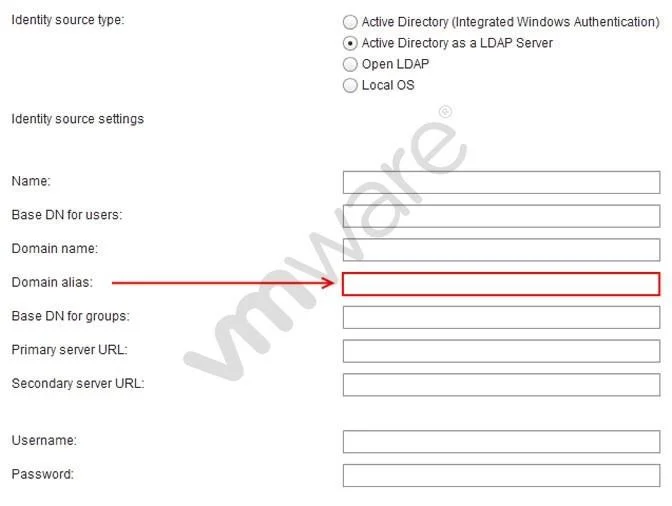
Options
- AThe domain's NetBIOS name.
- BThe fully qualified domain name.
- Cvsphere.local
- DA user defined label.
How the community answered
(28 responses)- A86% (24)
- B7% (2)
- C4% (1)
- D4% (1)
Why each option
The Domain alias field in vCenter SSO for an Active Directory over LDAP identity source must be set to the domain's NetBIOS name, which allows users to authenticate using the short DOMAIN\username format.
The Domain alias in vCenter SSO corresponds to the NetBIOS (short) name of the Active Directory domain, such as 'CORP' for 'corp.example.com'. This value is what users type before the backslash when logging in with the DOMAIN\username format, and it must match the actual NetBIOS name registered in AD.
The fully qualified domain name (e.g., corp.example.com) belongs in the Domain name field, not the alias field.
vsphere.local is the default built-in SSO domain and has no relevance to an external Active Directory identity source alias.
The alias must reflect the actual NetBIOS name so authentication resolves correctly; an arbitrary user-defined label would cause login failures.
Concept tested: vCenter SSO Active Directory LDAP identity source configuration
Source: https://docs.vmware.com/en/VMware-vSphere/8.0/vsphere-authentication/GUID-B23B1360-8838-4FF2-B074-71643C4CB040.html
Topics
Community Discussion
No community discussion yet for this question.