
2V0-621 · Question #247
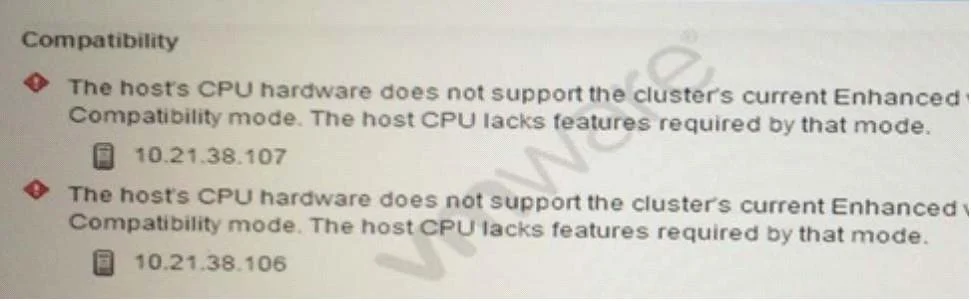
Click the Exhibit. Which three conditions would explain the error? (Choose three.)
The correct answer is A. EVC is using a newer baseline than the hosts in the Exhibit. B. The ESXi hosts have an incompatible version of Streaming SIMD Extensions (SSE). C. The ESXi hosts have the Intel No-Execute feature disabled. EVC errors occur when the cluster baseline requires CPU features that the ESXi hosts do not support or do not have enabled.
Question
Click the Exhibit. Which three conditions would explain the error? (Choose three.)
Exhibit
Options
- AEVC is using a newer baseline than the hosts in the Exhibit.
- BThe ESXi hosts have an incompatible version of Streaming SIMD Extensions (SSE).
- CThe ESXi hosts have the Intel No-Execute feature disabled.
- DEVC is using an order baseline than the hosts in the Exhibit.
- EThe EXSi host does not have the Intel VT-d feature enabled.
How the community answered
(27 responses)- A78% (21)
- D7% (2)
- E15% (4)
Why each option
EVC errors occur when the cluster baseline requires CPU features that the ESXi hosts do not support or do not have enabled.
A newer EVC baseline requires CPU features beyond what the installed hosts support, causing a compatibility mismatch that prevents the hosts from satisfying the cluster's CPU feature mask.
EVC baselines include SSE feature requirements; if a host's SSE version is incompatible with the baseline, the host cannot satisfy the CPU feature mask required by EVC.
EVC baselines require the Intel NX/XD (No-Execute) bit to be enabled; if this feature is disabled in the host BIOS, the host fails EVC compatibility validation.
An older EVC baseline is less restrictive and only uses a subset of the hosts' CPU capabilities, so it would not generate a compatibility error.
VT-d (Intel Virtualization for Directed I/O) enables PCIe device passthrough and is not part of the EVC CPU feature mask or baseline requirements.
Concept tested: EVC baseline CPU compatibility requirements
Source: https://docs.vmware.com/en/VMware-vSphere/7.0/com.vmware.vsphere.vcenterhost.doc/GUID-8D8125EB-1ABC-4D9D-B7FB-A53CD8245498.html
Topics
Community Discussion
No community discussion yet for this question.