
2V0-621 · Question #203
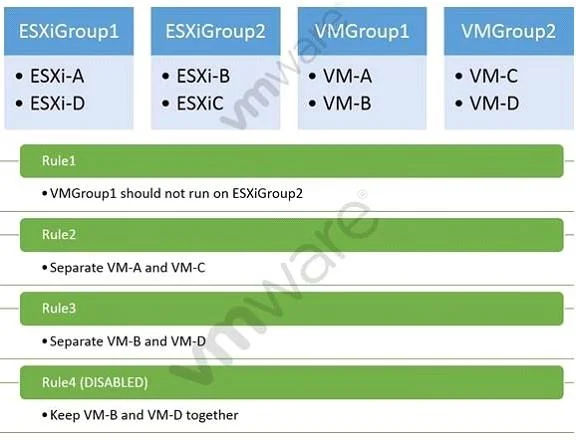
Refer to the Exhibit. An administrator has configured Distributed Resource Scheduler (DRS) groups and Affinity Rules as shown in the Exhibit. Based on the exhibit, which two statements are true?…
The correct answer is B. A new conflicting affinity rule will be disabled by default. D. The administrator must disable Rule3 in order to enable Rule4. When a newly created DRS affinity rule conflicts with an existing rule, vSphere disables the new rule by default, requiring the administrator to manually resolve the conflict.
Question
Refer to the Exhibit. An administrator has configured Distributed Resource Scheduler (DRS) groups and Affinity Rules as shown in the Exhibit. Based on the exhibit, which two statements are true? (Choose two.)
Exhibit
Options
- AIf ESXi-A and ESXi-D failed, VM-A and VM-B would not failover.
- BA new conflicting affinity rule will be disabled by default.
- CVM-B and VM-D can run on the same hosts.
- DThe administrator must disable Rule3 in order to enable Rule4.
How the community answered
(59 responses)- A19% (11)
- B69% (41)
- C12% (7)
Why each option
When a newly created DRS affinity rule conflicts with an existing rule, vSphere disables the new rule by default, requiring the administrator to manually resolve the conflict.
vSphere HA failover operates independently of DRS host availability; even with ESXi-A and ESXi-D failed, HA would still attempt to restart VMs on the remaining hosts unless a Must Run rule makes it impossible.
vSphere automatically disables a newly created affinity rule that conflicts with an existing enabled rule, preserving the prior rule's enforcement and flagging the conflict for administrator review.
Based on the exhibit's anti-affinity rules separating VM-B and VM-D, those VMs are configured to run on different hosts, making it incorrect that they can run on the same host.
Because Rule3 is the existing enabled rule and Rule4 conflicts with it, Rule4 is disabled by default - the administrator must explicitly disable Rule3 first before Rule4 can be enabled and enforced.
Concept tested: DRS affinity rule conflict resolution and disable behavior
Source: https://docs.vmware.com/en/VMware-vSphere/8.0/vsphere-resource-management/GUID-2FB90EF5-7733-4095-8B66-F10D6C57B820.html
Topics
Community Discussion
No community discussion yet for this question.