
2V0-33.22 · Question #30
A cloud administrator Is tasked with deploying two virtual machines (APP01 and APP02) to a software-defined data center (SDDC) with multiple clusters hosted In VMware Cloud on AWS based on the…
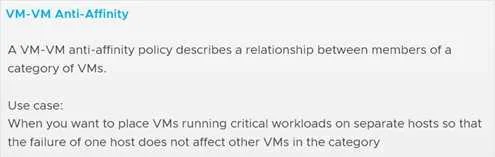
The correct answer is B. Create a VM-VM anti-affinity policy. E. Create a VM-Host affinity policy. B (VM-VM Anti-Affinity) satisfies the first requirement by forcing APP01 and APP02 onto separate hosts - this is exactly what anti-affinity between two VMs does. E (VM-Host Affinity) satisfies the second requirement by binding both VMs to the three licensed hosts within Cluster…
Question
A cloud administrator Is tasked with deploying two virtual machines (APP01 and APP02) to a software-defined data center (SDDC) with multiple clusters hosted In VMware Cloud on AWS based on the following requirements:
- APP01 and APP02 should NOT run on the same host.
- Only three hosts in the SDDC are entitled to run the software
installed on these servers.
- All entitled hosts are in cluster 1.
Which two actions should the administrator take to meet these requirements? (Choose two)
Exhibit
Options
- ACreate a Disable DRS vMotion policy.
- BCreate a VM-VM anti-affinity policy.
- CDeploy APP01 to Cluster 1 and APP02 to cluster 2.
- DCreate a VM-Host anti-affinity policy.
- ECreate a VM-Host affinity policy.
How the community answered
(58 responses)- A12% (7)
- B78% (45)
- C7% (4)
- D3% (2)
Explanation
B (VM-VM Anti-Affinity) satisfies the first requirement by forcing APP01 and APP02 onto separate hosts - this is exactly what anti-affinity between two VMs does. E (VM-Host Affinity) satisfies the second requirement by binding both VMs to the three licensed hosts within Cluster 1, ensuring they never migrate to unlicensed hosts.
Why the distractors fail:
- A (Disable DRS vMotion) prevents migrations but does nothing to enforce host separation or licensing boundaries.
- C (Deploy to different clusters) separates the VMs but puts APP02 in Cluster 2 where no entitled hosts exist, violating the licensing requirement.
- D (VM-Host Anti-Affinity) does the opposite of what's needed - it keeps VMs away from specified hosts, not restricted to them.
Memory tip: Think "affinity = magnet toward, anti-affinity = magnet away." You need VMs attracted to licensed hosts (VM-Host affinity) and repelled from each other (VM-VM anti-affinity). When you see licensing/entitlement constraints + host separation together, that's always the affinity/anti-affinity pair.
Topics
Community Discussion
No community discussion yet for this question.