
210-250 · Question #105
For which kind of attack does an attacker use known information in encrypted files to break the encryption scheme for the rest of
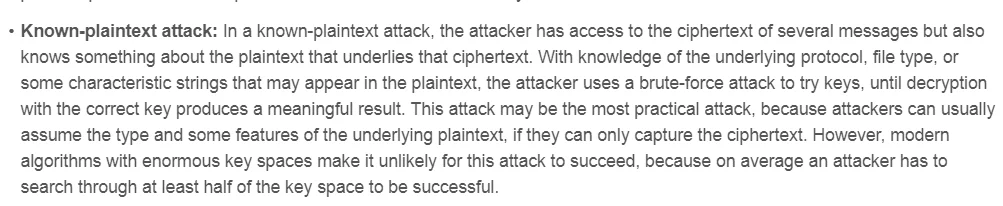
The correct answer is A. known-plaintext. A known-plaintext attack leverages pairs of known plaintext and their corresponding ciphertext to deduce the encryption key or crack the cipher for additional encrypted data.
Question
For which kind of attack does an attacker use known information in encrypted files to break the encryption scheme for the rest of
Exhibit
Options
- Aknown-plaintext
- Bknown-ciphertext
- Cunknown key
- Dman in the middle
How the community answered
(23 responses)- A91% (21)
- B4% (1)
- C4% (1)
Why each option
A known-plaintext attack leverages pairs of known plaintext and their corresponding ciphertext to deduce the encryption key or crack the cipher for additional encrypted data.
In a known-plaintext attack, the attacker possesses one or more samples of both original plaintext and the corresponding encrypted ciphertext. By analyzing these pairs, the attacker can reverse-engineer the encryption key or exploit algorithmic patterns to decrypt other ciphertext produced by the same key. This technique was famously used against the Enigma cipher during World War II.
A ciphertext-only attack means the attacker has only the encrypted output and no known plaintext samples, making it a strictly harder problem than a known-plaintext attack.
Unknown key is not a recognized cryptographic attack classification - the encryption key is unknown to the attacker by definition in virtually every attack scenario, so this term has no specific meaning.
A man-in-the-middle attack involves intercepting or relaying communications between two parties in transit, which is unrelated to using plaintext-ciphertext pairs to break a cipher.
Concept tested: Known-plaintext cryptographic attack technique
Source: https://csrc.nist.gov/glossary/term/known_plaintext_attack
Topics
Community Discussion
No community discussion yet for this question.