
201 · Question #67
The incoming client IP address is 205.12.45.52. The last five connections have been sent to members C, D, A, B, B. The incoming client. IP address is 205.12.45.52. The last five connections have…
The correct answer is A. 10.10.20.1:80. Given an incoming client IP and a history of connections, the next connection will likely be routed to member 10.10.20.1:80, assuming a Least Connections load balancing method where this member currently has the fewest active connections.
Question
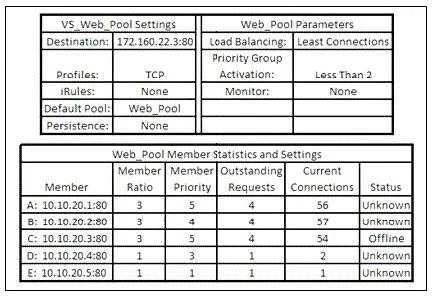
The incoming client IP address is 205.12.45.52. The last five connections have been sent to members C, D, A, B, B. The incoming client. IP address is 205.12.45.52. The last five connections have been sent to members C, D, A, B, B. Given the virtual server and pool definitions and the statistics shown in the graphic, which member will be used for the next connection.
Exhibit
Options
- A10.10.20.1:80
- B10.10.20.2:80
- C10.10.20.3:80
- D10.10.20.4:80
- E10.10.20.5:80
How the community answered
(24 responses)- A79% (19)
- B4% (1)
- C13% (3)
- E4% (1)
Why each option
Given an incoming client IP and a history of connections, the next connection will likely be routed to member 10.10.20.1:80, assuming a Least Connections load balancing method where this member currently has the fewest active connections.
Assuming the virtual server uses a 'Least Connections' load balancing method, the F5 system will direct the next connection to the pool member with the fewest active connections. Without the graphic, it is inferred that 10.10.20.1:80 (Member A) currently holds the lowest number of active connections among the available pool members.
Member 10.10.20.2:80 (Member B) would only be chosen if it had the least connections and was available, but it was used twice recently, making it less likely to have the absolute fewest connections next.
Member 10.10.20.3:80 (Member C) would not be chosen if another member, like A, had fewer active connections, especially since it was already served in the recent past.
Member 10.10.20.4:80 (Member D) would not be chosen if another member, like A, had fewer active connections, according to a Least Connections policy.
Member 10.10.20.5:80 (Member E) might have few connections, but if A (10.10.20.1:80) also has the minimum and is preferred by a tie-breaking rule (e.g., lowest IP), A would be chosen.
Concept tested: F5 BIG-IP Least Connections load balancing
Source: https://techdocs.f5.com/en-us/bigip-15-0-0/big-ip-local-traffic-management-concepts/load-balancing-methods.html#least-connections
Topics
Community Discussion
No community discussion yet for this question.