
201 · Question #205
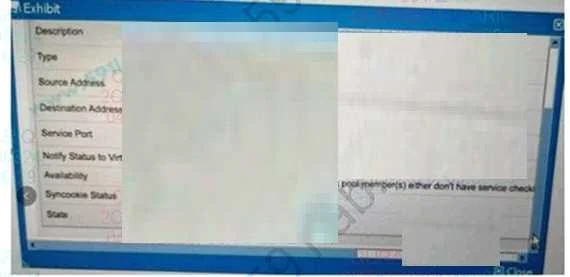
Refer to the exhibit. A BIG-IP Administrator configures the Virtual Server to pass HTTP traffic. Users report that they are unable to access the application. What should the administrator do to…
The correct answer is D. Reconfigure the Pool Members. Users are unable to access an application through a configured HTTP Virtual Server, indicating an issue with how the Virtual Server directs traffic to backend resources.
Question
Refer to the exhibit. A BIG-IP Administrator configures the Virtual Server to pass HTTP traffic. Users report that they are unable to access the application. What should the administrator do to resolve this issue?
Exhibit
Options
- AChange the Virtual Server name
- BDisable .he State
- CReconfigure the Source Address
- DReconfigure the Pool Members
How the community answered
(40 responses)- A5% (2)
- B3% (1)
- C8% (3)
- D85% (34)
Why each option
Users are unable to access an application through a configured HTTP Virtual Server, indicating an issue with how the Virtual Server directs traffic to backend resources.
Changing the Virtual Server name is an administrative action and does not affect the traffic processing or routing capabilities.
Disabling the state (assuming a typo for 'the State') is not a standard or effective way to resolve application access issues caused by backend server problems.
Reconfiguring the Source Address typically impacts client connection filtering or SNAT behavior, but is less likely to be the primary cause of complete application inaccessibility compared to issues with pool members.
The Virtual Server routes client traffic to a pool of backend servers, known as pool members. If these pool members are misconfigured (e.g., incorrect IP/port, health monitor issues, disabled state), the Virtual Server cannot forward traffic to them, leading to application inaccessibility.
Concept tested: F5 BIG-IP Virtual Server traffic routing to Pools
Source: https://techdocs.f5.com/en-us/bigip-15-0-0/big-ip-local-traffic-manager-concepts/virtual-servers.html
Topics
Community Discussion
No community discussion yet for this question.