
200-901 · Question #98
Drag and Drop Question Drag and drop the requests from the left into the correct order on the right to create and check the path trace between two devices using Cisco DNA center API. Answer:
The correct answer is POST /api/system/v1/auth/token; GET /api/v1/network-device/ and choose IP of source and destination devices; POST /api/v1/flow-analysis; GET /api/v1/flow-analysis/{flowAnalysisId}. The correct sequence for performing a path trace using Cisco DNA Center APIs involves authenticating, identifying devices, initiating the trace, and then polling for the trace results.
Question
Exhibit
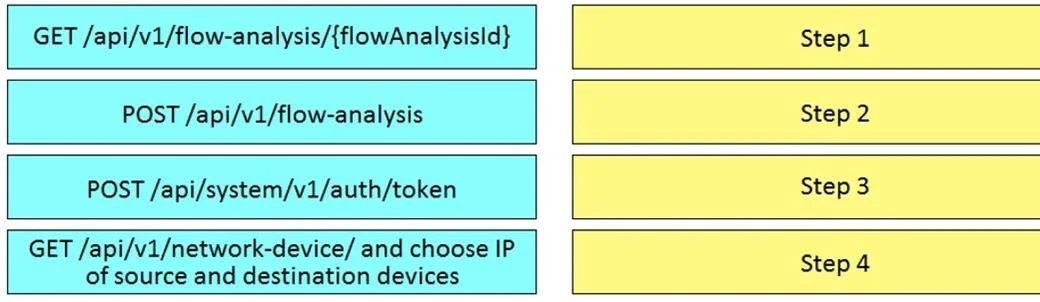
Answer Area
Drag items
Correct arrangement
- POST /api/system/v1/auth/token
- GET /api/v1/network-device/ and choose IP of source and destination devices
- POST /api/v1/flow-analysis
- GET /api/v1/flow-analysis/{flowAnalysisId}
Explanation
The correct sequence for performing a path trace using Cisco DNA Center APIs involves authenticating, identifying devices, initiating the trace, and then polling for the trace results.
Approach. The correct interaction involves dragging the API calls into the following order:
-
Step 1: POST /api/system/v1/auth/token
- Reasoning: The first step in almost any API interaction with Cisco DNA Center is authentication. This API call is used to obtain a valid authentication token, which is essential for authorizing subsequent API requests. Without a token, other API calls will be rejected.
-
Step 2: GET /api/v1/network-device/ and choose IP of source and destination devices
- Reasoning: To perform a path trace (flow analysis), you need to specify the source and destination devices. This GET request allows you to list all managed network devices, from which you can identify and select the specific IP addresses or device IDs for your path trace, fulfilling the requirement to 'choose IP of source and destination devices'.
-
Step 3: POST /api/v1/flow-analysis
- Reasoning: Once authenticated and having identified the source and destination devices, this POST request is used to initiate a new flow analysis or path trace. The request body will include details like source IP, destination IP, and potentially protocol and port information. This call creates the analysis job and typically returns a
flowAnalysisId.
- Reasoning: Once authenticated and having identified the source and destination devices, this POST request is used to initiate a new flow analysis or path trace. The request body will include details like source IP, destination IP, and potentially protocol and port information. This call creates the analysis job and typically returns a
-
Step 4: GET /api/v1/flow-analysis/{{flowAnalysisId}}
- Reasoning: Path trace analysis is an asynchronous operation, meaning it doesn't complete instantly. After initiating the analysis with the POST request (Step 3), you use the returned
flowAnalysisIdto periodically query the status and retrieve the results of the path trace. This GET request fetches the current state and eventually the detailed outcome of the flow analysis.
- Reasoning: Path trace analysis is an asynchronous operation, meaning it doesn't complete instantly. After initiating the analysis with the POST request (Step 3), you use the returned
Common mistakes.
- common_mistake. Common mistakes include failing to authenticate first, attempting to retrieve flow analysis results before initiating the analysis, or mixing up the purpose of POST (to create/initiate) and GET (to retrieve/query). For example, placing
GET /api/v1/flow-analysis/{{flowAnalysisId}}beforePOST /api/v1/flow-analysisis incorrect because there would be noflowAnalysisIdto query. Similarly, starting withPOST /api/v1/flow-analysiswithout an authentication token would result in an authorization failure.
Concept tested. The core concept tested is the practical understanding of a typical RESTful API workflow, specifically within the context of Cisco DNA Center for network automation. This includes API authentication, resource discovery, initiating asynchronous tasks, and polling for task completion and results. It assesses knowledge of HTTP methods (POST for creating/acting, GET for retrieving) and the logical sequence of operations in a multi-step API process.
Topics
Community Discussion
No community discussion yet for this question.