
200-901 · Question #74
Drag and Drop Question Drag and drop the descriptions from the left onto the correct application deployment models on the right. Answer:
The correct answer is environment where you pay only for the resources that you consume; shared compute platform that is offered over the internet; offers a self-service, elastic compute environment from a dedicated set of physical resources; provides an approach for overflow traffic to burst out to meet peak demands; provides a low-latency compute capability close to the data source. This question tests the understanding of different cloud computing deployment models and their defining characteristics by requiring the test-taker to match descriptions to the correct model.
Question
Drag and Drop Question Drag and drop the descriptions from the left onto the correct application deployment models on the right. Answer:
Exhibit
Answer Area
Drag items
Correct arrangement
- environment where you pay only for the resources that you consume
- shared compute platform that is offered over the internet
- offers a self-service, elastic compute environment from a dedicated set of physical resources
- provides an approach for overflow traffic to burst out to meet peak demands
- provides a low-latency compute capability close to the data source
Explanation
This question tests the understanding of different cloud computing deployment models and their defining characteristics by requiring the test-taker to match descriptions to the correct model.
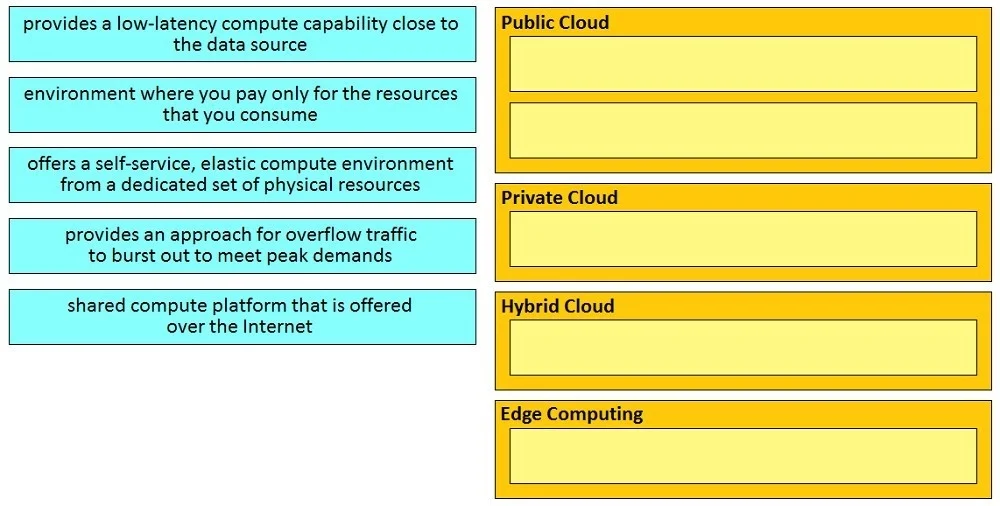
Approach. The correct interaction involves dragging each description to its appropriate cloud deployment model based on its defining characteristics. The correct mapping is as follows:
- Public Cloud:
- 'environment where you pay only for the resources that you consume': This describes the pay-as-you-go, consumption-based model inherent to public cloud services.
- 'shared compute platform that is offered over the Internet': This is a foundational definition of a public cloud, where resources are shared among multiple tenants and accessed via the internet.
- Private Cloud:
- 'offers a self-service, elastic compute environment from a dedicated set of physical resources': This highlights the cloud characteristics (self-service, elastic) combined with a dedicated, private infrastructure.
- Hybrid Cloud:
- 'provides an approach for overflow traffic to burst out to meet peak demands': This is known as cloud bursting, a key capability of a hybrid cloud model that leverages public cloud resources to augment private cloud capacity during demand spikes.
- Edge Computing:
- 'provides a low-latency compute capability close to the data source': This is the core principle of edge computing - bringing computation closer to where data is generated to reduce latency and bandwidth usage.
Common mistakes.
- common_mistake. A common mistake would be confusing the characteristics of public versus private cloud, or misunderstanding the unique aspects of hybrid and edge computing. For instance, placing 'shared compute platform that is offered over the Internet' under Private Cloud would be incorrect because private clouds are typically dedicated and not necessarily shared over the public internet, though they can offer self-service. Similarly, attributing 'low-latency compute capability close to the data source' to any other cloud model besides Edge Computing would be wrong, as that specific benefit is the primary driver for edge deployments. Confusing 'cloud bursting' with a purely public or private cloud scenario would also be incorrect, as bursting is a characteristic of hybrid environments. Incorrectly assigning the 'pay-as-you-go' model to a private cloud is wrong, as private clouds typically involve significant upfront investment and managed capacity rather than consumption-based billing for individual resources.
Concept tested. Cloud computing deployment models, including Public Cloud, Private Cloud, Hybrid Cloud, and Edge Computing, along with their key characteristics, benefits, and operational models.
Topics
Community Discussion
No community discussion yet for this question.