
200-901 · Question #73
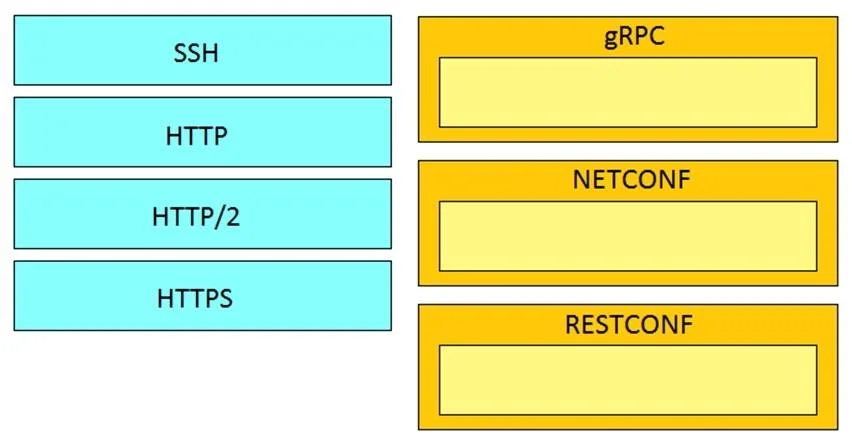
Drag and Drop Question Drag and drop the network automation interfaces from the left onto the transport protocols that they support on the right. Answer:
The correct answer is HTTP/2; SSH; HTTPS. This question tests the understanding of common network automation interfaces and the specific transport protocols they utilize for communication, requiring the test-taker to correctly associate gRPC with HTTP/2, NETCONF with SSH, and RESTCONF with HTTPS.
Question
Exhibit
Answer Area
Drag items
Correct arrangement
- HTTP/2
- SSH
- HTTPS
Explanation
This question tests the understanding of common network automation interfaces and the specific transport protocols they utilize for communication, requiring the test-taker to correctly associate gRPC with HTTP/2, NETCONF with SSH, and RESTCONF with HTTPS.
Approach. The correct approach involves dragging each transport protocol from the left column to its corresponding network automation interface on the right, based on industry standards and common implementation practices, as demonstrated in the solution image.
- Drag 'HTTP/2' to 'gRPC': gRPC (gRPC Remote Procedure Call) is a modern, high-performance, open-source universal RPC framework developed by Google. It is specifically designed to run on HTTP/2, leveraging its features like multiplexing, streaming, and header compression for efficient communication.
- Drag 'SSH' to 'NETCONF': NETCONF (Network Configuration Protocol) is an IETF standard protocol used for configuring, monitoring, and managing network devices. While NETCONF can use several transport mappings, SSH (Secure Shell) is the most widely adopted and secure transport for NETCONF, providing authentication, authorization, and encryption for management sessions.
- Drag 'HTTPS' to 'RESTCONF': RESTCONF is an HTTP-based protocol, also standardized by the IETF, that provides a programmatic interface for accessing network device data modeled with YANG. It adheres to RESTful principles and uses HTTPS (HTTP over TLS/SSL) as its secure transport mechanism to ensure data confidentiality and integrity during configuration and operational data retrieval.
- Leave 'HTTP' unmatched: The generic 'HTTP' without a specified version or security layer is not the primary or most appropriate dedicated transport for any of the listed modern network automation interfaces, which either prioritize security (HTTPS for RESTCONF) or specific performance features (HTTP/2 for gRPC). Therefore, 'HTTP' is correctly left without a match among the given options.
Common mistakes.
- common_mistake. A common mistake is incorrectly associating the transport protocols due to a lack of specific knowledge about each automation interface's preferred or mandated transport. For example:
- Incorrectly using 'HTTP' for gRPC or RESTCONF: Some might mistakenly drag 'HTTP' to gRPC or RESTCONF. However, gRPC specifically requires HTTP/2, and RESTCONF, while HTTP-based, mandates HTTPS for secure and standard operation, making these more precise and correct matches than generic HTTP.
- Mixing up SSH with web-based protocols: Another error could be dragging 'SSH' to RESTCONF, possibly confusing its general secure remote access capabilities with RESTCONF's specific reliance on HTTP/HTTPS.
- Ignoring the distinction between HTTP versions and security: Not understanding that HTTP/2 is a distinct version of HTTP optimized for performance, and HTTPS is HTTP secured with TLS, can lead to incorrect pairings. For instance, putting 'HTTP' with gRPC instead of 'HTTP/2' shows a lack of understanding of gRPC's core transport requirement.
- Attempting to match all options: Test-takers might try to force a match for 'HTTP', assuming all draggable items must be used. However, 'HTTP' is often excluded when more specific (HTTP/2, HTTPS) or secure options are available for modern automation protocols.
Concept tested. The core concept being tested is the understanding of common network automation protocols (gRPC, NETCONF, RESTCONF) and their respective underlying transport layer protocols (HTTP/2, SSH, HTTPS). This includes knowing the specific technical requirements and standard practices for secure and efficient communication in network automation.
Topics
Community Discussion
No community discussion yet for this question.