
200-901 · Question #558
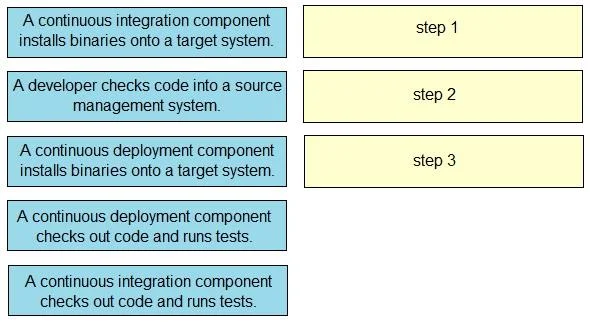
Drag and Drop Question Drag and drop the steps from the left into the order on the right to implement a CI/CD toolchain. Not all options are used. Answer:
The correct answer is A developer checks code into a source management system.; A continuous integration component checks out code and runs tests.; A continuous deployment component installs binaries onto a target system.; A continuous deployment component checks out code and runs tests. The question requires ordering the fundamental steps of a CI/CD toolchain, starting from code commit, through integration and testing, and finally to deployment.
Question
Drag and Drop Question Drag and drop the steps from the left into the order on the right to implement a CI/CD toolchain. Not all options are used. Answer:
Exhibit
Answer Area
Drag items
Correct arrangement
- A developer checks code into a source management system.
- A continuous integration component checks out code and runs tests.
- A continuous deployment component installs binaries onto a target system.
- A continuous deployment component checks out code and runs tests.
Explanation
The question requires ordering the fundamental steps of a CI/CD toolchain, starting from code commit, through integration and testing, and finally to deployment.
Approach. The correct interaction is to drag and drop the options into the sequence that accurately represents a standard CI/CD workflow:
- Drag 'A developer checks code into a source management system.' to 'step 1'. This is the initiating action in any CI/CD pipeline, where a developer commits new or updated code to a version control system.
- Drag 'A continuous integration component checks out code and runs tests.' to 'step 2'. Once code is committed, the Continuous Integration (CI) system is triggered. Its primary function is to fetch the latest code (check out), build it, and run automated tests to ensure code quality and integration correctness.
- Drag 'A continuous deployment component installs binaries onto a target system.' to 'step 3'. Following a successful CI build and testing phase, the Continuous Deployment (CD) component takes the verified and built artifacts (binaries) and automates their installation or deployment to a target environment (e.g., testing, staging, or production servers). This completes the basic CI/CD flow from code change to live application.
Common mistakes.
- common_mistake. Common mistakes include confusing the roles of CI and CD components. For example:
- 'A continuous integration component installs binaries onto a target system.' is incorrect for CI. CI's primary role is to build and test code, producing binaries/artifacts. Installation/deployment of these binaries is the responsibility of the CD component.
- 'A continuous deployment component checks out code and runs tests.' is incorrect for CD. While CD might run post-deployment sanity checks, checking out raw code and running primary integration tests are core functions of the CI component, which occurs earlier in the pipeline. CD focuses on deploying already built and tested artifacts. Incorrectly ordering these steps would show a misunderstanding of the sequential nature of a CI/CD pipeline, where code commit precedes integration, which precedes deployment.
Concept tested. The core concept being tested is the fundamental understanding of Continuous Integration (CI) and Continuous Deployment (CD) principles, the distinct roles of CI and CD components, and the typical workflow sequence in a modern DevOps toolchain.
Topics
Community Discussion
No community discussion yet for this question.