
200-901 · Question #55
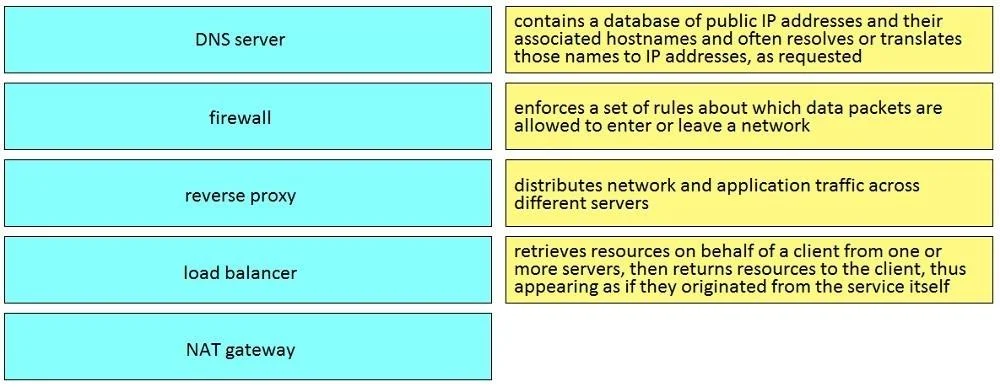
Drag and Drop Questions Drag and drop the network component names from the left onto the correct descriptions on the right. Not all options are used. Answer:
The correct answer is DNS server; firewall; load balancer; reverse proxy. This drag-and-drop question tests the candidate's understanding of fundamental network component functions by matching component names to their descriptions.
Question
Drag and Drop Questions Drag and drop the network component names from the left onto the correct descriptions on the right. Not all options are used. Answer:
Exhibit
Answer Area
Drag items
Correct arrangement
- DNS server
- firewall
- load balancer
- reverse proxy
Explanation
This drag-and-drop question tests the candidate's understanding of fundamental network component functions by matching component names to their descriptions.
Approach. To answer correctly, each description must be matched with its precise network component:
- The description 'contains a database of public IP addresses and their associated hostnames and often resolves or translates those names to IP addresses, as requested' accurately defines a DNS server. This component is fundamental for name resolution on the internet.
- The description 'enforces a set of rules about which data packets are allowed to enter or leave a network' is the classic definition of a firewall. Firewalls are critical for network security.
- The description 'distributes network and application traffic across different servers' is the primary function of a load balancer. Load balancers enhance availability and scalability by spreading incoming requests.
- The description 'retrieves resources on behalf of a client from one or more servers, then returns resources to the client, thus appearing as if they originated from the service itself' describes a reverse proxy. A reverse proxy sits in front of web servers and acts as an intermediary for client requests.
Therefore, the correct interactions are:
- Drag 'DNS server' to the first description.
- Drag 'firewall' to the second description.
- Drag 'load balancer' to the third description.
- Drag 'reverse proxy' to the fourth description. 'NAT gateway' is the unused option.
Common mistakes.
- common_mistake. A common mistake is confusing a 'load balancer' with a 'reverse proxy'. While many reverse proxies include load balancing functionality, their core unique description involves retrieving resources on behalf of a client and appearing as the origin. A load balancer's primary definition focuses purely on distributing traffic. Another mistake might be incorrectly assigning the firewall's role, perhaps confusing it with other security tools or basic routing, or not recognizing the specific name-resolution function of a DNS server. Misplacing 'NAT gateway' would also be incorrect, as none of the descriptions match its function of providing outbound internet connectivity for private networks while translating private IP addresses to a public one.
Concept tested. Core networking components and their specific functions, including DNS, firewalls, load balancers, and reverse proxies.
Topics
Community Discussion
No community discussion yet for this question.