
200-901 · Question #497
Drag and Drop Question Refer to the exhibit. Drag and drop the code from the bottom onto the box where the code is missing to configure the GigabitEthernet 3 interface. Not all options are used…
The correct answer is interface.ip.address.primary.address; interface.ip.address.primary.mask. This question tests the ability to configure a network interface's primary IP address and mask using the YDK library in Python, based on understanding YANG data models and CRUD operations.
Question
Drag and Drop Question Refer to the exhibit. Drag and drop the code from the bottom onto the box where the code is missing to configure the GigabitEthernet 3 interface. Not all options are used. Answer:
Exhibit
Answer Area
Drag items
Correct arrangement
- interface.ip.address.primary.address
- interface.ip.address.primary.mask
Explanation
This question tests the ability to configure a network interface's primary IP address and mask using the YDK library in Python, based on understanding YANG data models and CRUD operations.
Approach. To correctly configure the GigabitEthernet 3 interface, the following interactions are required:
- First blank: The script needs to instantiate the
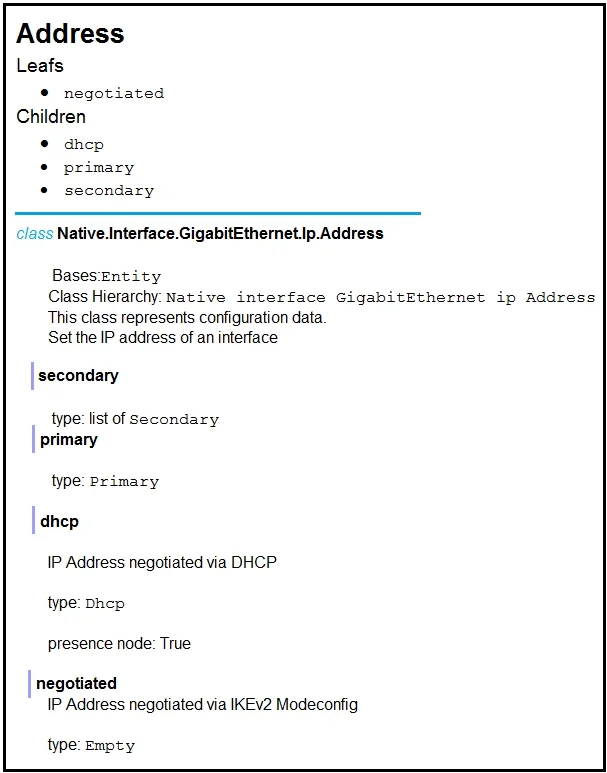
interfaceobject. Based on thenameanddescriptionattributes that follow, it's clear we're dealing with a GigabitEthernet interface. The YDK class for this ismodel.Native.Interface.GigabitEthernet(). Dragmodel.Native.Interface.GigabitEthernet()to this blank. - Second blank: This line assigns the IP address '172.16.10.10'. Referring to the YDK documentation (Image 1), IP addresses are configured under
interface.ip.address. For a static, main IP, it falls underprimary.address. So, draginterface.ip.address.primary.addressto this blank. - Third blank: This line assigns the subnet mask '255.255.255.0'. Following the pattern for the primary IP address, the mask attribute would be
primary.mask. So, draginterface.ip.address.primary.maskto this blank. - Fourth blank: After defining the
interfaceobject with its details, the configuration needs to be applied to the device. Since this is the initial configuration for this specific interface and address, a 'create' operation is used with theCRUDService. So, dragcrud.create(provider, interface)to this blank.
This sequence correctly initializes the interface object, assigns its primary IP address and mask using the YDK model structure, and then applies the configuration to the device.
Common mistakes.
- common_mistake. Using
crud.update(provider, interface)instead ofcrud.create(provider, interface)is incorrect becauseupdateis used to modify an existing configuration, whilecreateis for establishing a new configuration, which is the scenario presented here. Placinginterface.ip.maskorinterface.ip.address.virtual.maskfor the IP address or subnet mask would be wrong because the YDK data model (as shown in the documentation) specifies the path asinterface.ip.address.primary.addressandinterface.ip.address.primary.maskfor a primary static IP configuration. Other options likeinterface.ip.address.secondary.addressare incorrect because the scenario implicitly asks for the primary IP configuration.
Concept tested. Network automation using Python and YDK (YANG Development Kit), understanding of YANG data models for network interface configuration (specifically IP address and subnet mask assignment), and knowledge of YDK's CRUD (Create, Read, Update, Delete) operations.
Topics
Community Discussion
No community discussion yet for this question.