
200-901 · Question #422
Refer to the exhibit. The internal client cannot access the app server, but access still works for clients on the Internet. Which two actions resolve the issue? (Choose two.) \
The correct answer is B. Add a host route on the server to the client. E. Add a host route on the client to the server. The internal client cannot reach the app server because neither endpoint has a route to the other's subnet. Adding host routes on both the client and server restores bidirectional connectivity without affecting internet access, which routes through an intermediary device.
Question
Refer to the exhibit. The internal client cannot access the app server, but access still works for clients on the Internet. Which two actions resolve the issue? (Choose two.) \
Exhibit
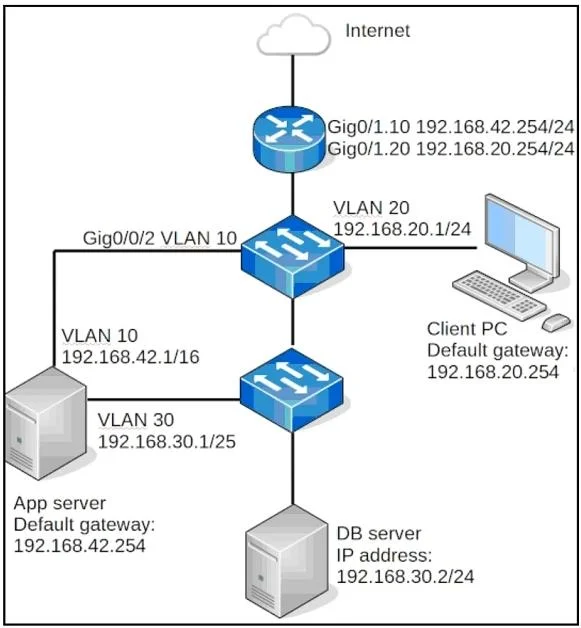
Options
- AMove port Gi0/0/2 to VLAN 20.
- BAdd a host route on the server to the client.
- CChange the subnet length on the client to 16.
- DChange the subnet length on the server to 24.
- EAdd a host route on the client to the server.
How the community answered
(20 responses)- A10% (2)
- B80% (16)
- C5% (1)
- D5% (1)
Why each option
The internal client cannot reach the app server because neither endpoint has a route to the other's subnet. Adding host routes on both the client and server restores bidirectional connectivity without affecting internet access, which routes through an intermediary device.
Changing the VLAN assignment of Gi0/0/2 modifies layer-2 segmentation but does not address the layer-3 routing gap that prevents the internal client from exchanging packets with the server.
The server lacks a return route to the internal client's subnet, so reply packets are dropped before reaching the client. Adding a host route on the server pointing to the client's address completes the return path.
Expanding the client subnet mask to /16 does not create a valid route to the server and may cause the client to incorrectly assume the server is locally reachable, worsening the mismatch.
Changing the server subnet mask to /24 adjusts the server's local network boundary but does not install routes that allow the client and server to exchange traffic across their separate subnets.
The client has no route to the server's subnet, so outbound packets cannot be forwarded correctly. Adding a host route on the client pointing to the server's address resolves the missing forward path.
Concept tested: Static host routes resolving missing bidirectional routing
Source: https://www.cisco.com/c/en/us/td/docs/ios-xml/ios/iproute_pi/configuration/xe-16/iri-xe-16-book/ip-route-pi-xe.html
Topics
Community Discussion
No community discussion yet for this question.