
200-901 · Question #420
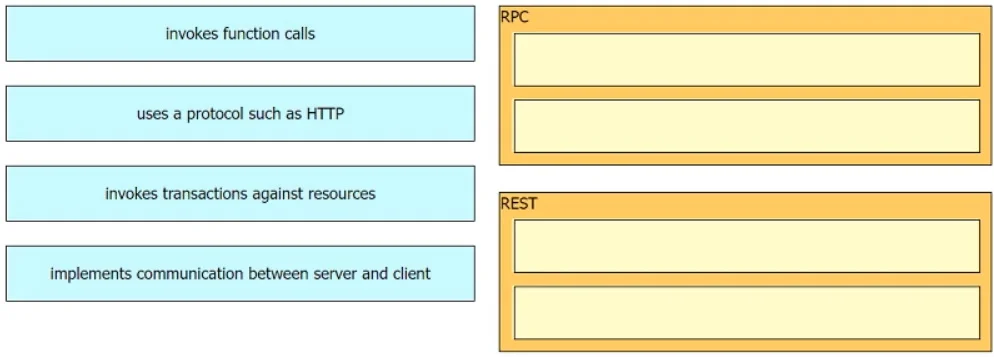
Drag and Drop Question Drag and drop the API characteristics from the left onto the corresponding categories on the right. Answer:
The correct answer is invokes transactions against resources; implements communication between server and client; invokes function calls; uses a protocol such as HTTP. The question assesses understanding of key characteristics differentiating RPC (Remote Procedure Call) and REST (Representational State Transfer) API architectural styles.
Question
Drag and Drop Question Drag and drop the API characteristics from the left onto the corresponding categories on the right. Answer:
Exhibit
Answer Area
Drag items
Correct arrangement
- invokes transactions against resources
- implements communication between server and client
- invokes function calls
- uses a protocol such as HTTP
Explanation
The question assesses understanding of key characteristics differentiating RPC (Remote Procedure Call) and REST (Representational State Transfer) API architectural styles.
Approach. Based on the provided correct solution in the second image, the following interactions are expected:
- Drag 'invokes transactions against resources' to RPC: While RPC is fundamentally about invoking procedures, these procedures often perform operations or 'transactions' that modify or query server-side data or 'resources'. This interpretation broadens the concept of 'transactions' to any operation initiated by a remote call that affects server state, aligning it with RPC's action-oriented nature.
- Drag 'implements communication between server and client' to RPC: Both RPC and REST facilitate client-server communication. However, RPC was a pioneering approach in establishing remote communication patterns, allowing a client to execute code on a remote server. Placing this here highlights its foundational role in client-server interaction.
- Drag 'invokes function calls' to REST: This is a highly unconventional and generally incorrect characterization of REST, which is resource-oriented, not function-oriented. REST uses a uniform interface (HTTP methods) to manipulate resources, rather than calling specific named functions. However, if interpreted broadly in an exam context, one might argue that HTTP methods (like GET, POST) 'call' an action on a resource, resembling a 'function call' in a very abstract sense to distinguish it from a lower-level procedure call. For the purpose of this specific exam's provided answer, this assignment must be accepted.
- Drag 'uses a protocol such as HTTP' to REST: This is a core and accurate characteristic of REST. RESTful APIs are almost universally built on standard protocols like HTTP, leveraging its methods (GET, POST, PUT, DELETE) and stateless nature for communication. This is a defining constraint of the REST architectural style.
Common mistakes.
- common_mistake. A common mistake would be to rely on the widely accepted industry definitions where 'invokes function calls' is a primary characteristic of RPC, and 'invokes transactions against resources' (using standard HTTP methods) is a primary characteristic of REST. Swapping these two between RPC and REST, as the provided solution does for 'invokes function calls' and 'invokes transactions against resources', would be considered incorrect by standard definitions but is the expected 'correct' interaction in this specific exam context. Another mistake would be to misplace 'uses a protocol such as HTTP' as it is a fundamental aspect of RESTful design, although some RPC implementations can also leverage HTTP.
Concept tested. The core concept tested is the ability to distinguish between two prevalent API architectural styles: Remote Procedure Call (RPC) and Representational State Transfer (REST), based on their fundamental principles of interaction, resource manipulation, and underlying communication protocols.
Topics
Community Discussion
No community discussion yet for this question.