
200-901 · Question #300
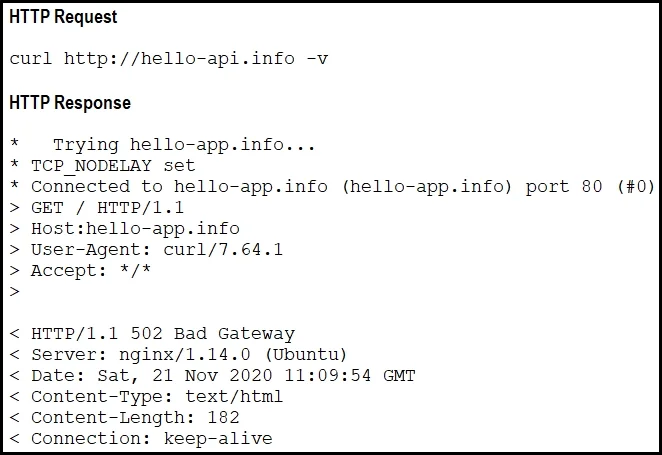
Refer to the exhibit. A developer cannot reach the web application behind an NGINX load balancer. The developer sends a request to an application FQDN with cURL but gets an HTTP 502 response. Which…
The correct answer is A. Fix errors in the server configuration, which is behind the load balancer. An HTTP 502 'Bad Gateway' error means the NGINX load balancer received an invalid or no response from the upstream backend server(s) it was trying to forward the request to. The load balancer itself is operational (it returned a response), so option B is incorrect. The cURL…
Question
Refer to the exhibit. A developer cannot reach the web application behind an NGINX load balancer. The developer sends a request to an application FQDN with cURL but gets an HTTP 502 response. Which action solves the problem?
Exhibit
Options
- AFix errors in the server configuration, which is behind the load balancer.
- BBring up the load balancer to the active state.
- CFix errors in the cURL request sent by the client.
- DChange the default gateway on the load balancer to an active one.
How the community answered
(47 responses)- A77% (36)
- B2% (1)
- C13% (6)
- D9% (4)
Explanation
An HTTP 502 'Bad Gateway' error means the NGINX load balancer received an invalid or no response from the upstream backend server(s) it was trying to forward the request to. The load balancer itself is operational (it returned a response), so option B is incorrect. The cURL request reached the load balancer fine (it responded), ruling out option C. A default gateway issue (option D) would typically cause a different connectivity failure. The root cause is a misconfiguration or error in the backend application servers behind the load balancer, so fixing the server configuration (option A) resolves the 502 error.
Topics
Community Discussion
No community discussion yet for this question.