
200-901 · Question #162
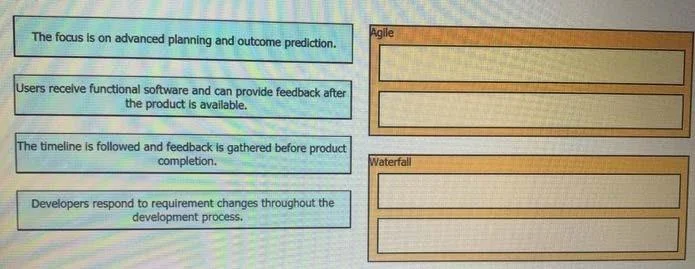
Drag and Drop Question Drag and drop the characteristics from the left onto the corresponding software development methodologies on the right. Answer:
The correct answer is The focus is on advanced planning and outcome prediction.; Developers respond to requirement changes throughout the development process.; Users receive functional software and can provide feedback after the product is available.; The timeline is followed and feedback is gathered before product completion. This question assesses the understanding of key characteristics that differentiate Agile and Waterfall software development methodologies through a drag-and-drop interface.
Question
Drag and Drop Question Drag and drop the characteristics from the left onto the corresponding software development methodologies on the right. Answer:
Exhibit
Answer Area
Drag items
Correct arrangement
- The focus is on advanced planning and outcome prediction.
- Developers respond to requirement changes throughout the development process.
- Users receive functional software and can provide feedback after the product is available.
- The timeline is followed and feedback is gathered before product completion.
Explanation
This question assesses the understanding of key characteristics that differentiate Agile and Waterfall software development methodologies through a drag-and-drop interface.
Approach. The correct interaction involves dragging the characteristics from the left to their corresponding methodology on the right, based on widely accepted industry definitions:
- For Agile (top right target box), drag the following characteristics:
- 'Users receive functional software and can provide feedback after the product is available.' - Agile methodologies emphasize iterative delivery of working software increments, allowing for continuous and early user feedback on usable portions of the product.
- 'Developers respond to requirement changes throughout the development process.' - Agile embraces change and values adaptability to evolving requirements, making changes an integral part of the development lifecycle rather than locking them in upfront.
- For Waterfall (bottom right target box), drag the following characteristics:
- 'The focus is on advanced planning and outcome prediction.' - Waterfall is characterized by extensive upfront planning, detailed requirements gathering, and an attempt to define the entire project scope and predict outcomes before development begins.
- 'The timeline is followed and feedback is gathered before product completion.' - Waterfall projects adhere to a predefined sequential timeline. Feedback is typically gathered at specific phase gates (e.g., requirements sign-off, design review) or late during user acceptance testing, largely before the final product release but not continuously throughout active development.
Common mistakes.
- common_mistake. Common mistakes often stem from a superficial understanding of these methodologies or from potential misinterpretation of the terms, particularly if the second image is taken as a literal solution:
- Misconception of 'planning' in Agile: Incorrectly dragging 'The focus is on advanced planning and outcome prediction' to Agile (as partially depicted in the second image's Agile box) is a mistake. While Agile involves planning (e.g., sprint planning, release planning), it is adaptive and iterative, not based on rigid, advanced, long-term prediction typical of Waterfall.
- Misunderstanding of feedback and delivery in Waterfall: Incorrectly dragging 'Users receive functional software and can provide feedback after the product is available' to Waterfall (as partially depicted in the second image's Waterfall box) is a significant error. Waterfall typically delivers the full product much later in the lifecycle, making feedback 'after the product is available' very late and costly for significant changes. This characteristic is a cornerstone of Agile's continuous delivery and feedback loops.
- Confusing flexibility with rigidity: A common error is failing to distinguish how each methodology handles requirement changes. Agile responds to changes throughout the process, whereas Waterfall aims to minimize changes after initial requirements are set, making them difficult and expensive to implement.
Concept tested. The core concept tested is the fundamental understanding of the distinguishing characteristics, principles, and lifecycle approaches of Agile and Waterfall software development methodologies. This includes recognizing their differing stances on planning, change management, user involvement, and feedback mechanisms.
Topics
Community Discussion
No community discussion yet for this question.