
200-901 · Question #142
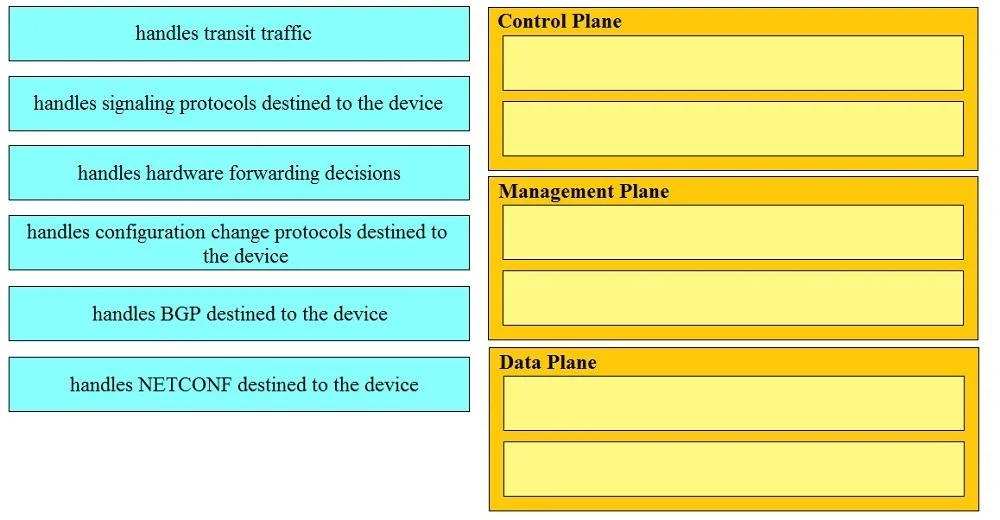
Drag and Drop Question Drag and drop the function on the left onto the type of plane that handles the function on the right. v Answer:
The correct answer is handles signaling protocols destined to the device; handles BGP destined to the device; handles configuration change protocols destined to the device; handles NETCONF destined to the device; handles transit traffic; handles hardware forwarding decisions. This question tests the understanding of the three fundamental planes in network devices: Data Plane, Control Plane, and Management Plane, by requiring the categorization of specific functions into their respective planes.
Question
Drag and Drop Question Drag and drop the function on the left onto the type of plane that handles the function on the right. v Answer:
Exhibit
Answer Area
Drag items
Correct arrangement
- handles signaling protocols destined to the device
- handles BGP destined to the device
- handles configuration change protocols destined to the device
- handles NETCONF destined to the device
- handles transit traffic
- handles hardware forwarding decisions
Explanation
This question tests the understanding of the three fundamental planes in network devices: Data Plane, Control Plane, and Management Plane, by requiring the categorization of specific functions into their respective planes.
Approach. The correct approach involves understanding the distinct responsibilities of each networking plane and matching the functions accordingly.
-
Data Plane: This plane is responsible for forwarding user traffic (transit traffic) through the device based on decisions made by the control plane. These operations are often performed by specialized hardware for speed.
- 'handles transit traffic' - This is the primary function of the data plane, moving packets from an ingress to an egress interface.
- 'handles hardware forwarding decisions' - Modern network devices use ASICs and other hardware to accelerate data plane operations.
- Therefore, these two functions are dragged to the 'Data Plane'.
-
Control Plane: This plane is responsible for building and maintaining the forwarding tables (e.g., routing tables, MAC address tables) that the data plane uses. It involves protocols that exchange routing and signaling information.
- 'handles signaling protocols destined to the device' - Signaling protocols (like LDP, RSVP) terminate on the device's control plane to establish paths and update state.
- 'handles BGP destined to the device' - BGP is a routing protocol. When BGP updates are received, they are processed by the control plane to update the routing information base.
- Therefore, these two functions are dragged to the 'Control Plane'.
-
Management Plane: This plane is responsible for managing, monitoring, and configuring the device itself. It involves protocols used for administrative access and device configuration.
- 'handles configuration change protocols destined to the device' - Protocols used to alter device settings fall under management.
- 'handles NETCONF destined to the device' - NETCONF is a specific protocol designed for network device configuration and management, a clear management plane function.
- Therefore, these two functions are dragged to the 'Management Plane'.
Common mistakes.
- common_mistake. A common mistake is confusing the roles of the Control Plane and the Management Plane, as both involve protocols terminating on the device's CPU. For example, incorrectly placing 'handles BGP destined to the device' into the Management Plane, or 'handles NETCONF destined to the device' into the Control Plane. The distinction lies in their purpose: Control Plane protocols (like BGP, OSPF, LDP) build and maintain the network's forwarding state, while Management Plane protocols (like NETCONF, SNMP, SSH for CLI) configure and monitor the device itself. Another mistake could be assigning data plane functions, such as 'handles transit traffic' or 'handles hardware forwarding decisions', to the control or management planes, which operate at a higher logical level focused on decision-making and configuration, not direct packet forwarding.
Concept tested. The three planes of networking architecture: Data Plane (or Forwarding Plane), Control Plane, and Management Plane, and their distinct functions within a network device.
Topics
Community Discussion
No community discussion yet for this question.