
200-901 · Question #130
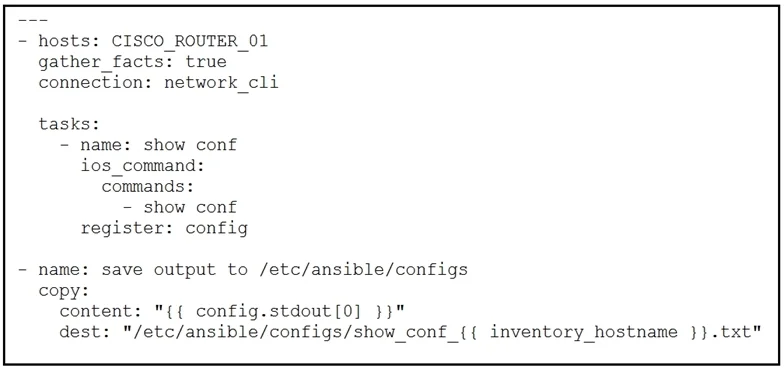
Refer to the exhibit. What is the result of executing this Ansible playbook?
The correct answer is B. The playbook backs up the running configuration of CISCO_ROUTER_01. The correct answer is B. A typical Ansible playbook that backs up a running configuration uses the 'ios_command' or 'ios_config' module with a 'show running-config' command and saves the output to a file on the control node. The key distinction is between 'running-config'…
Question
Refer to the exhibit. What is the result of executing this Ansible playbook?
Exhibit
Options
- AThe playbook copies a new start-up configuration to CISCO_ROUTER_01.
- BThe playbook backs up the running configuration of CISCO_ROUTER_01.
- CThe playbook backs up the start-up configuration of C1SCO_ROUTER_01.
- DThe playbook copies a new running configuration to CISCO_ROUTER_01.
How the community answered
(17 responses)- A6% (1)
- B88% (15)
- C6% (1)
Explanation
The correct answer is B. A typical Ansible playbook that backs up a running configuration uses the 'ios_command' or 'ios_config' module with a 'show running-config' command and saves the output to a file on the control node. The key distinction is between 'running-config' (active configuration in RAM) and 'startup-config' (saved configuration in NVRAM). When the playbook uses 'show running-config' and registers/saves the output locally, it is performing a backup of the running configuration. Answer A and D are incorrect because copying a configuration to the device would use a 'src' parameter pushing content to the device. Answer C is incorrect because startup-config backup would use 'show startup-config'.
Topics
Community Discussion
No community discussion yet for this question.