
200-301 · Question #886
Drag and Drop Question Drag and drop the statements about wireless architectures from the left onto the architectures on the right. Answer:
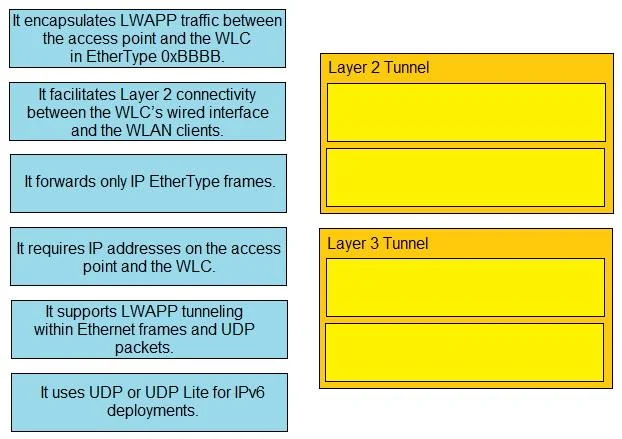
The correct answer is It facilitates Layer 2 connectivity between the WLC's wired interface and the WLAN clients.; It encapsulates LWAPP traffic between the access point and the WLC in EtherType 0xBBBB.; It requires IP addresses on the access point and the WLC.; It supports LWAPP tunneling within Ethernet frames and UDP packets.; It uses UDP or UDP Lite for IPv6 deployments.; It forwards only IP EtherType frames. Wireless LAN architectures differ fundamentally in how they handle traffic between access points and controllers. Layer 2 LWAPP uses EtherType 0xBBBB to encapsulate traffic within Ethernet frames, facilitating Layer 2 connectivity and only forwarding IP EtherType frames, making…
Question
Exhibit
Answer Area
Drag items
Correct arrangement
- It facilitates Layer 2 connectivity between the WLC's wired interface and the WLAN clients.
- It encapsulates LWAPP traffic between the access point and the WLC in EtherType 0xBBBB.
- It requires IP addresses on the access point and the WLC.
- It supports LWAPP tunneling within Ethernet frames and UDP packets.
- It uses UDP or UDP Lite for IPv6 deployments.
- It forwards only IP EtherType frames.
Explanation
Wireless LAN architectures differ fundamentally in how they handle traffic between access points and controllers. Layer 2 LWAPP uses EtherType 0xBBBB to encapsulate traffic within Ethernet frames, facilitating Layer 2 connectivity and only forwarding IP EtherType frames, making it suitable for same-subnet deployments. Layer 3 LWAPP requires IP addresses on both the AP and WLC, uses UDP packets for tunneling, and supports UDP/UDP Lite for IPv6, enabling communication across routed networks.
Topics
Community Discussion
No community discussion yet for this question.