
200-301 · Question #862
Refer to the exhibit. An OSPF neighbor relationship must be configured using these guidelines: - R1 is only permitted to establish a neighbor with R2 - R1 will never participate in DR elections - R1…
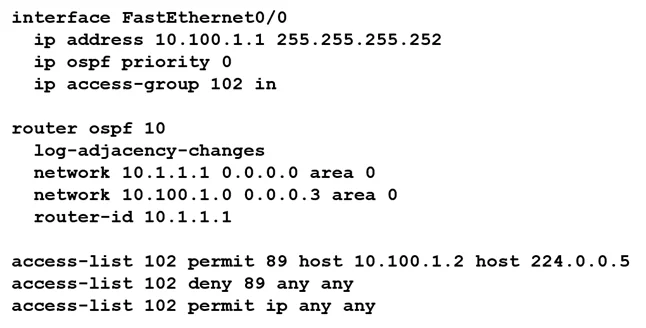
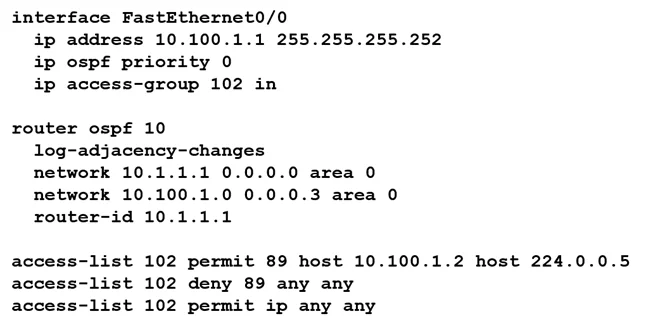
The correct answer is A. interface FastEthernet0/0 ip address 10.100.1.1 255.255.255.252 ip ospf priority 0 ip access-group 102 in router ospf 10 log-adjacency-changes network 10.1.1.1 0.0.0.0 area 0 network 10.100.1.0 0.0.0.3 area 0 router-id 10.1.1.1 access-list 102 permit 89 host 10.100.1.2 host 224.' access-list 102 deny 89 any any access-list 102 permit ip any any. Option A is correct because it sets 'ip ospf priority 0' on the interface, which ensures R1 will never participate in DR/BDR elections (priority 0 = ineligible). The access-list uses protocol number 89 (OSPF) to permit OSPF traffic only from R2's IP (10.100.1.2), blocking OSPF…
Question
Exhibits
Options
- Ainterface FastEthernet0/0 ip address 10.100.1.1 255.255.255.252 ip ospf priority 0 ip access-group 102 in router ospf 10 log-adjacency-changes network 10.1.1.1 0.0.0.0 area 0 network 10.100.1.0 0.0.0.3 area 0 router-id 10.1.1.1 access-list 102 permit 89 host 10.100.1.2 host 224.' access-list 102 deny 89 any any access-list 102 permit ip any any
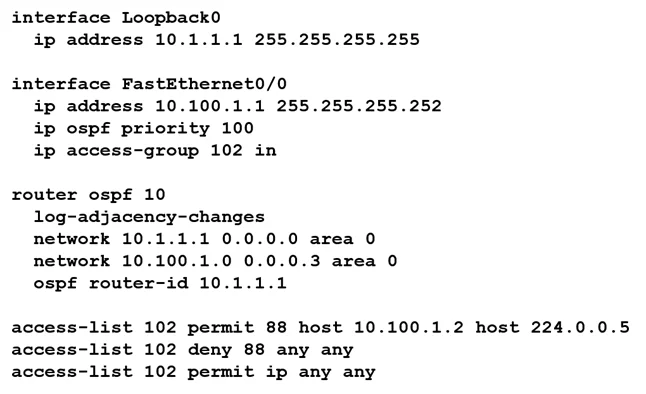
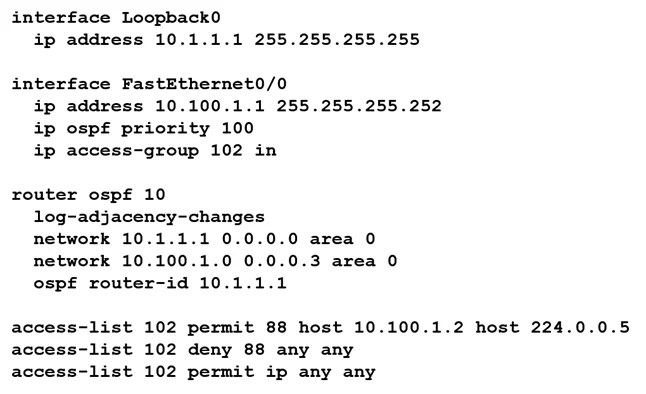
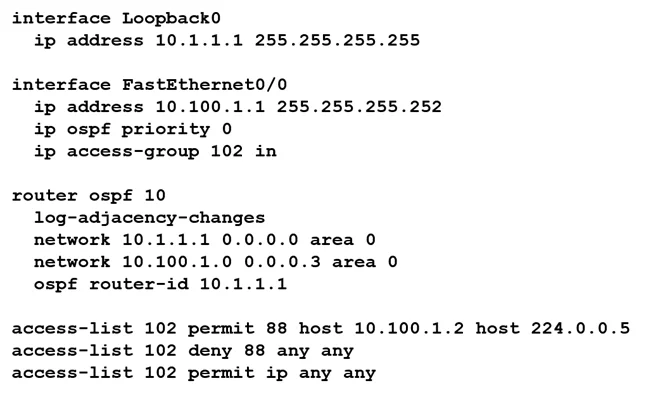
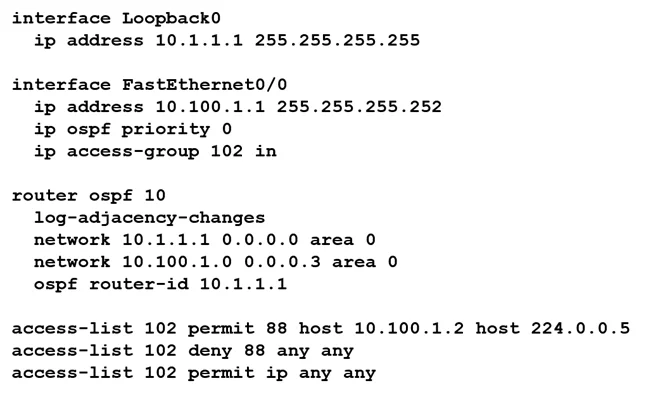
- Binterface Loopback0 ip address 10.1.1.1 255.255.255.255 interface FastEthernet0/0 ip address 10.100.1.1 255.255.255.252 ip ospf priority 100 ip access-group 102 in router ospf 10 log-adjacency-changes network 10.1.1.1 0.0.0.0 area 0 network 10.100.1.0 0.0.0.3 area 0 ospf router-id 10.1.1.1 access-list 102 permit 88 host 10.100.1.2 host 224.' access-list 102 deny 88 any any access-list 102 permit ip any any
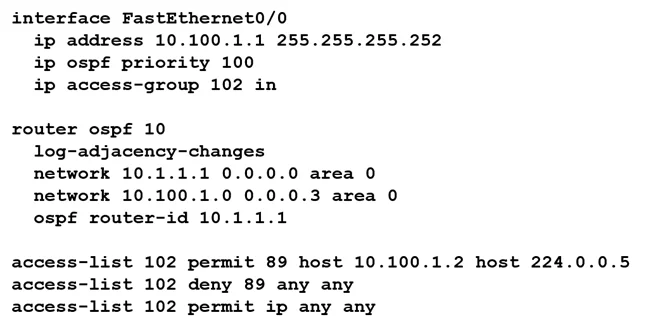
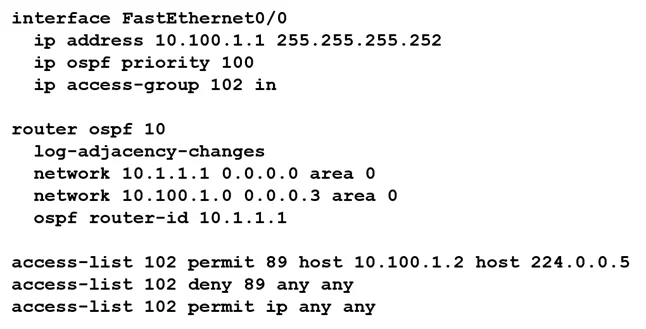
- Cinterface FastEthernet0/0 ip address 10.100.1.1 255.255.255.252 ip ospf priority 100 ip access-group 102 in router ospf 10 log-adjacency-changes network 10.1.1.1 0.0.0.0 area 0 network 10.100.1.0 0.0.0.3 area 0 ospf router-id 10.1.1.1 access-list 102 permit 89 host 10.100.1.2 host 224.' access-list 102 deny 89 any any access-list 102 permit ip any any
How the community answered
(20 responses)- A65% (13)
- B25% (5)
- C10% (2)
Explanation
Option A is correct because it sets 'ip ospf priority 0' on the interface, which ensures R1 will never participate in DR/BDR elections (priority 0 = ineligible). The access-list uses protocol number 89 (OSPF) to permit OSPF traffic only from R2's IP (10.100.1.2), blocking OSPF from any other neighbor, and the router-id is set to 10.1.1.1 as required. Note: while the question states router-id of 101.1.1 (likely a typo for 10.1.1.1), Option A matches all three stated requirements most accurately.
Topics
Community Discussion
No community discussion yet for this question.