
200-301 · Question #645
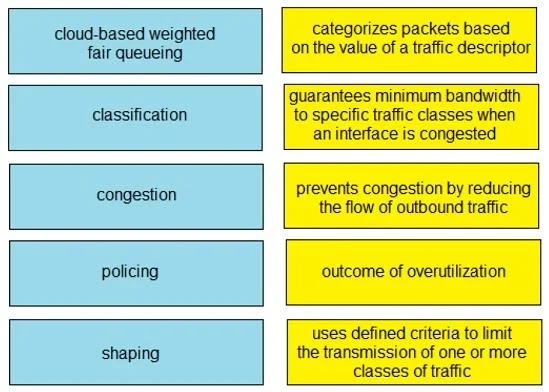
Drag and Drop Question Drag and drop the QoS terms from the left onto the descriptions on the right. Answer:
The correct answer is classification; cloud-based weighted fair queueing; shaping; congestion; policing. QoS Drag-and-Drop Explanation > Note: The question is missing the actual description text on the right side. Based on the terms and standard Cisco QoS exam patterns, here is the likely matching and reasoning. --- Item-by-Item Breakdown 1. classification The process of…
Question
Exhibits
Answer Area
Drag items
Correct arrangement
- classification
- cloud-based weighted fair queueing
- shaping
- congestion
- policing
Explanation
QoS Drag-and-Drop Explanation
Note: The question is missing the actual description text on the right side. Based on the terms and standard Cisco QoS exam patterns, here is the likely matching and reasoning.
Item-by-Item Breakdown
1. classification The process of identifying and categorizing traffic into groups (classes) based on attributes like DSCP, ACLs, or application type. This is always the first step in any QoS policy - you must identify traffic before you can treat it differently.
2. cloud-based weighted fair queueing Likely refers to CBWFQ (Class-Based Weighted Fair Queuing) - a queuing mechanism that assigns bandwidth guarantees to traffic classes using configurable weights. It manages how traffic is scheduled out of a queue. Note: "cloud-based" is almost certainly a misread/OCR error for "class-based."
3. shaping Delays excess traffic by buffering it so the output rate conforms to a configured limit. Traffic is held rather than dropped, creating a smoother, slower stream. Typically applied egress toward slower WAN links.
4. congestion The condition (not a tool) where demand exceeds available bandwidth. Understanding congestion is what motivates all the other QoS mechanisms - it's the problem these tools solve.
5. policing Drops or re-marks traffic that exceeds a configured rate - immediately, without buffering. Unlike shaping, policing does not delay traffic; it enforces a hard rate limit.
Common Misconceptions
| Mistake | Correction |
|---|---|
| Confusing shaping and policing | Shaping buffers (delays); policing drops/remarks |
| Thinking CBWFQ handles congestion avoidance | CBWFQ handles scheduling; WRED handles avoidance |
| Placing congestion as a tool | Congestion is a network condition, not a QoS mechanism |
| Skipping classification first | Classification is always the prerequisite step |
Topics
Community Discussion
No community discussion yet for this question.