
200-301 · Question #626
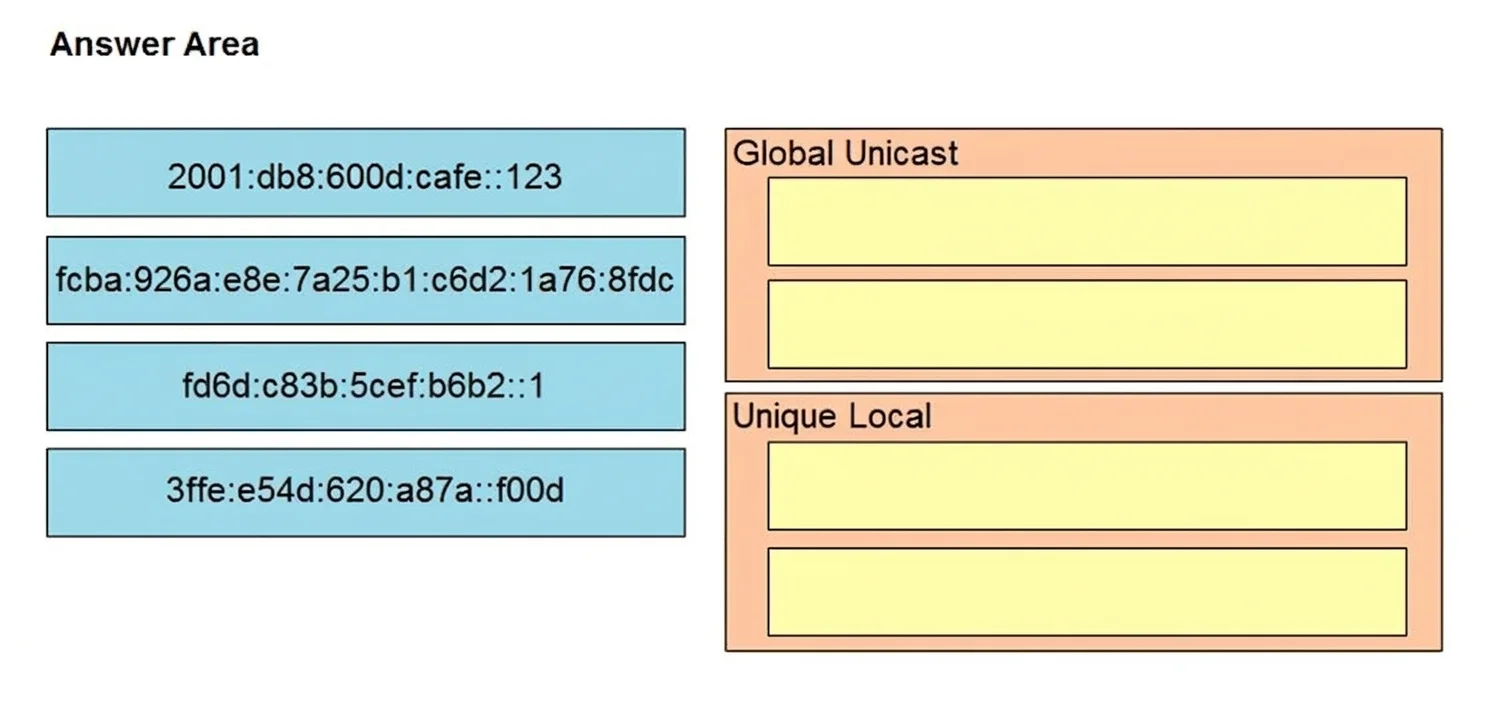
Drag and Drop Question Drag and drop the IPv6 addresses from the left onto the corresponding address types on the right. Answer:
The correct answer is Global Unicast: 2001:db8:600d:cafe::123; Global Unicast: 3ffe:e54d:620:a87a::f00d; Unique Local: fcba:926a:e8e:7a25:b1:c6d2:1a76:8fdc; Unique Local: fd6d:c83b:5cef:b6b2::1. IPv6 Address Classification Explanation The Two Address Types Global Unicast (GUA) - Publicly routable addresses. Defined by prefix 2000::/3, meaning the first 3 bits are 001. This covers the hex range 2000:: through 3fff::. Unique Local (ULA) - Private, non-routable addresses…
Question
Exhibit
Answer Area
Drag items
Correct arrangement
- Global Unicast: 2001:db8:600d:cafe::123
- Global Unicast: 3ffe:e54d:620:a87a::f00d
- Unique Local: fcba:926a:e8e:7a25:b1:c6d2:1a76:8fdc
- Unique Local: fd6d:c83b:5cef:b6b2::1
Explanation
IPv6 Address Classification Explanation
The Two Address Types
Global Unicast (GUA) - Publicly routable addresses. Defined by prefix 2000::/3, meaning the first 3 bits are 001. This covers the hex range 2000:: through 3fff::.
Unique Local (ULA) - Private, non-routable addresses (analogous to IPv4's RFC 1918 space). Defined by prefix fc00::/7, meaning the first 7 bits are 1111 110. This covers addresses starting with fc or fd.
Individual Placements
2001:db8:600d:cafe::123 -> Global Unicast
Starts with 2001. In binary: 0010 0000... - first 3 bits are 001, placing it in 2000::/3.
Common misconception:
2001:db8::/32is the documentation/example prefix (RFC 3849). Exam questions frequently use it as a GUA example anyway, and structurally it is a GUA by prefix rules.
3ffe:e54d:620:a87a::f00d -> Global Unicast
Starts with 3ffe. In binary: 0011 1111... - first 3 bits are still 001, so it falls within 2000::/3.
Note:
3ffe::/16was the old 6bone experimental prefix, deprecated by RFC 3701. However, it is still classified as GUA structurally. Exams test the prefix rule, not historical deprecation.
fcba:926a:... -> Unique Local
Starts with fc. In binary: 1111 1100 - first 7 bits are 1111 110, matching fc00::/7.
fd6d:c83b:... -> Unique Local
Starts with fd. In binary: 1111 1101 - first 7 bits are also 1111 110, matching fc00::/7.
Quick Identification Rules
| First hex digits | Type |
|---|---|
2 or 3 | Global Unicast |
fc or fd | Unique Local |
fe80 | Link-Local (not in this question) |
ff | Multicast (not in this question) |
Common Mistakes
- Confusing
fcvsfd: Both are ULA. Thefdprefix means the Global ID was locally generated (L-bit set);fcmeans centrally assigned. Both map to Unique Local on exams. - Dismissing
3ffeas non-GUA because 6bone is deprecated - structurally it is still GUA by the2000::/3prefix rule. - Treating
2001:db8::as special - it's documentation-only but still classified as GUA for exam purposes.
Topics
Community Discussion
No community discussion yet for this question.