
200-301 · Question #618
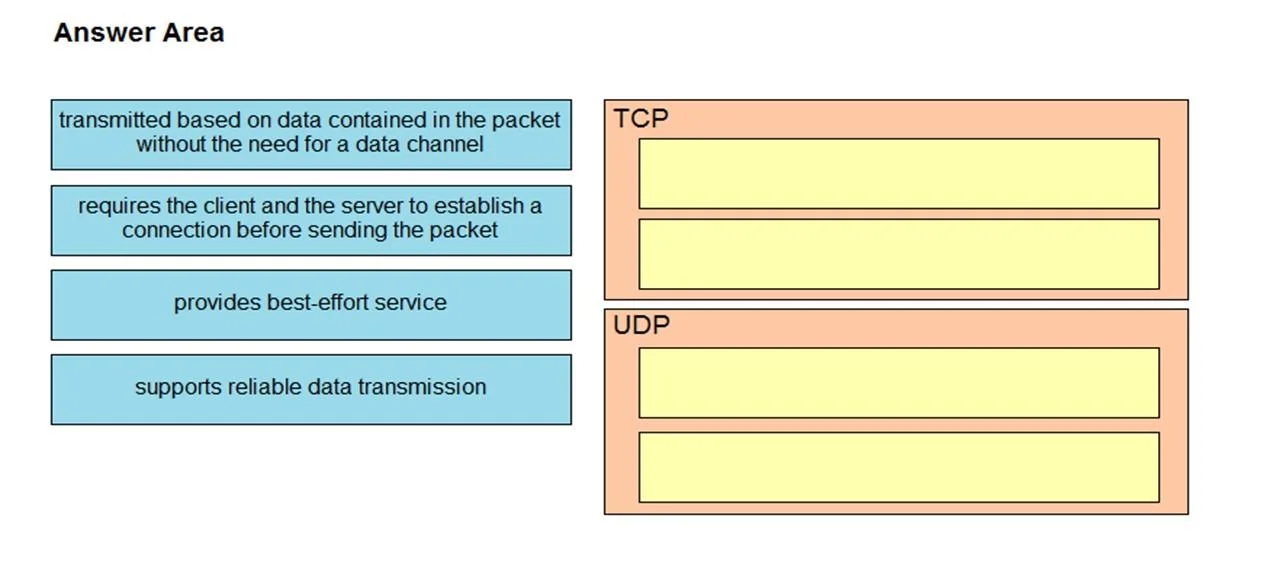
Drag and Drop Question Drag and drop the TCP or UDP details from the left onto their corresponding protocols on the right. Answer:
The correct answer is requires the client and the server to establish a connection before sending the packet; supports reliable data transmission; transmitted based on data contained in the packet without the need for a data channel; provides best-effort service. TCP (Transmission Control Protocol) is a connection-oriented protocol that requires a three-way handshake to establish a connection before data transmission and guarantees reliable, ordered delivery of data through acknowledgments and retransmission. UDP (User Datagram…
Question
Exhibit
Answer Area
Drag items
Correct arrangement
- requires the client and the server to establish a connection before sending the packet
- supports reliable data transmission
- transmitted based on data contained in the packet without the need for a data channel
- provides best-effort service
Explanation
TCP (Transmission Control Protocol) is a connection-oriented protocol that requires a three-way handshake to establish a connection before data transmission and guarantees reliable, ordered delivery of data through acknowledgments and retransmission. UDP (User Datagram Protocol) is a connectionless protocol that transmits data based solely on the destination information in the packet header without establishing a prior connection, and provides best-effort delivery with no guarantee of packet arrival, making it faster but less reliable. These characteristics make TCP ideal for applications requiring accuracy (e.g., file transfers, web browsing) while UDP suits time-sensitive applications (e.g., streaming, VoIP).
Topics
Community Discussion
No community discussion yet for this question.