
200-301 · Question #598
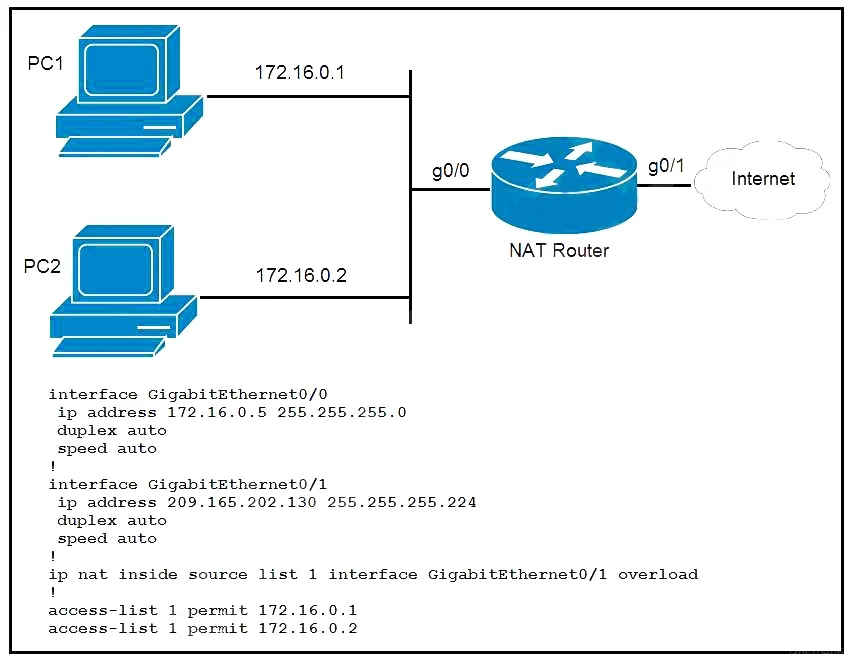
Refer to the exhibit. How should the configuration be updated to allow PC1 and PC2 access to the Internet?
The correct answer is B. Add either the ip nat {inside|outside} command under both interfaces. To enable Network Address Translation (NAT) for Internet access, both the internal and external interfaces must be explicitly configured with the ip nat inside and ip nat outside commands, respectively.
Question
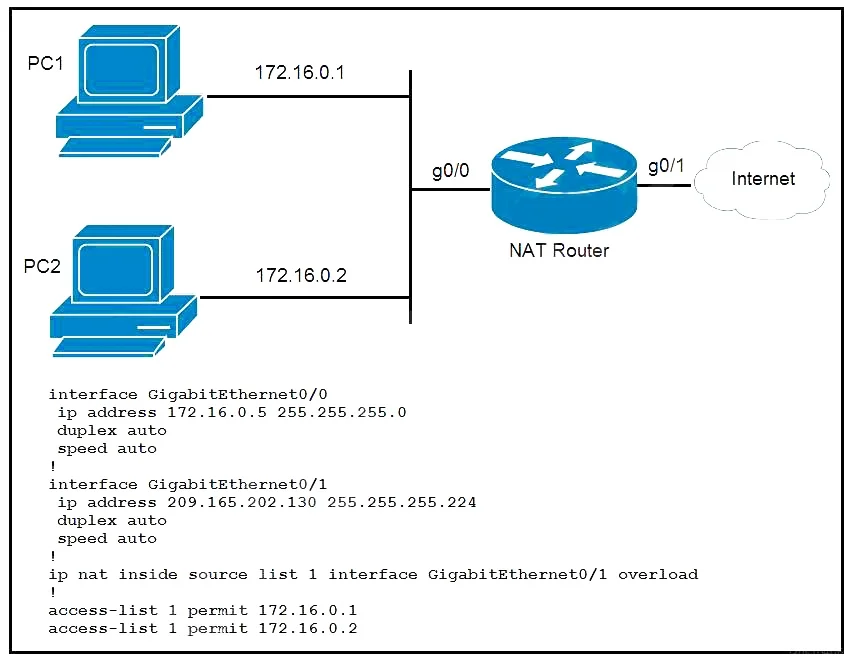
Refer to the exhibit. How should the configuration be updated to allow PC1 and PC2 access to the Internet?
Exhibits
Options
- AModify the configured number of the second access list.
- BAdd either the ip nat {inside|outside} command under both interfaces.
- CRemove the overload keyword from the ip nat inside source command.
- DChange the ip nat inside source command to use interface GigabitEthernet0/0.
How the community answered
(68 responses)- A6% (4)
- B54% (37)
- C26% (18)
- D13% (9)
Why each option
To enable Network Address Translation (NAT) for Internet access, both the internal and external interfaces must be explicitly configured with the `ip nat inside` and `ip nat outside` commands, respectively.
The exhibit only shows one access list (number 1), and modifying a non-existent second access list or changing the existing one's number would not resolve the fundamental issue of missing NAT interface commands.
For Cisco IOS NAT to function, interfaces must be explicitly designated as `ip nat inside` for the private network-facing interface (GigabitEthernet0/0 for PC1/PC2) and `ip nat outside` for the public network-facing interface (Serial0/0/0 for Internet access). Without these critical commands, the router cannot properly distinguish between inside and outside local/global addresses to perform NAT translations, thus preventing Internet access.
The `overload` keyword enables Port Address Translation (PAT), which is typically desired for multiple internal hosts sharing a single public IP address, and removing it would likely break connectivity for multiple users if only one public IP is available.
The `ip nat inside source` command specifies which interface's IP address (typically the outside interface's) should be used for the NAT translation; changing it to the inside interface (GigabitEthernet0/0) would use a private IP for the global address, preventing Internet access.
Concept tested: Cisco IOS NAT interface configuration
Source: https://www.cisco.com/c/en/us/td/docs/ios-xml/ios/ipaddr_nat/configuration/xe-3s/nat-xe-3s-book/ipnat-cfg-nat-ovrld.html
Topics
Community Discussion
No community discussion yet for this question.