
200-301 · Question #517
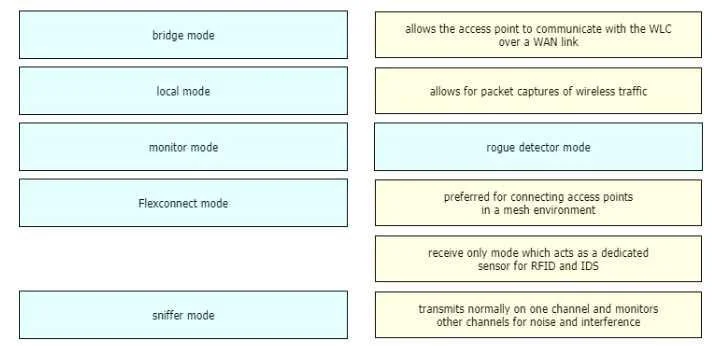
Drag and Drop Question Drag and drop the lightweight access point operation modes from the left onto the descriptions on the right. Answer:
The correct answer is local mode - allows for packet captures of wireless traffic; sniffer mode - receive only mode which acts as a dedicated sensor for RFID and IDS; rogue detector mode - transmits normally on one channel and monitors other channels for noise and interference; bridge mode - allows the access point to communicate with the WLC over a WAN link; FlexConnect mode - preferred for connecting access points in a mesh environment; monitor mode - rogue detector mode. In Cisco lightweight AP architecture, each mode serves a distinct purpose: Local mode is the default mode where the AP serves clients on one channel while scanning others for noise/interference; Sniffer mode puts the AP into a receive-only state to capture 802.11 traffic and…
Question
Drag and Drop Question Drag and drop the lightweight access point operation modes from the left onto the descriptions on the right. Answer:
Exhibit
Answer Area
Drag items
Correct arrangement
- local mode - allows for packet captures of wireless traffic
- sniffer mode - receive only mode which acts as a dedicated sensor for RFID and IDS
- rogue detector mode - transmits normally on one channel and monitors other channels for noise and interference
- bridge mode - allows the access point to communicate with the WLC over a WAN link
- FlexConnect mode - preferred for connecting access points in a mesh environment
- monitor mode - rogue detector mode
Explanation
In Cisco lightweight AP architecture, each mode serves a distinct purpose: Local mode is the default mode where the AP serves clients on one channel while scanning others for noise/interference; Sniffer mode puts the AP into a receive-only state to capture 802.11 traffic and forward it to a protocol analyzer; Monitor mode acts as a dedicated sensor for threats like rogue APs and IDS/WIDS without transmitting; Bridge mode connects two wired networks wirelessly or connects remote APs over a WAN; and FlexConnect (formerly HREAP) allows APs to locally switch traffic and remain functional even when WLC connectivity is lost, making it ideal for branch offices. The correct matching aligns each mode's name with its defining functional characteristic as defined in Cisco's CAPWAP/LWAPP architecture documentation.
Topics
Community Discussion
No community discussion yet for this question.