
200-301 · Question #508
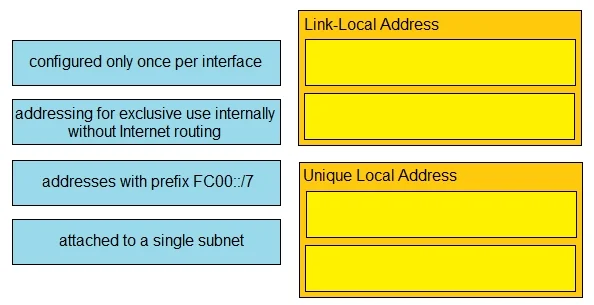
Drag and Drop Question Drag and drop the IPv6 address type characteristics from the left to the right. Answer:
The correct answer is Link-Local Address: attached to a single subnet; Link-Local Address: configured only once per interface; Unique Local Address: addresses with prefix FC00::/7; Unique Local Address: addressing for exclusive use internally without Internet routing. Link-Local addresses (FE80::/10) are automatically configured once per interface and are scoped only to a single subnet, meaning they cannot be routed beyond the local link. Unique Local addresses (FC00::/7, which includes the FD00::/8 range commonly used) are the IPv6…
Question
Exhibit
Answer Area
Drag items
Correct arrangement
- Link-Local Address: attached to a single subnet
- Link-Local Address: configured only once per interface
- Unique Local Address: addresses with prefix FC00::/7
- Unique Local Address: addressing for exclusive use internally without Internet routing
Explanation
Link-Local addresses (FE80::/10) are automatically configured once per interface and are scoped only to a single subnet, meaning they cannot be routed beyond the local link. Unique Local addresses (FC00::/7, which includes the FD00::/8 range commonly used) are the IPv6 equivalent of RFC 1918 private addresses - they are intended exclusively for internal use within an organization and are not routable on the public Internet.
Topics
Community Discussion
No community discussion yet for this question.