
200-301 · Question #50
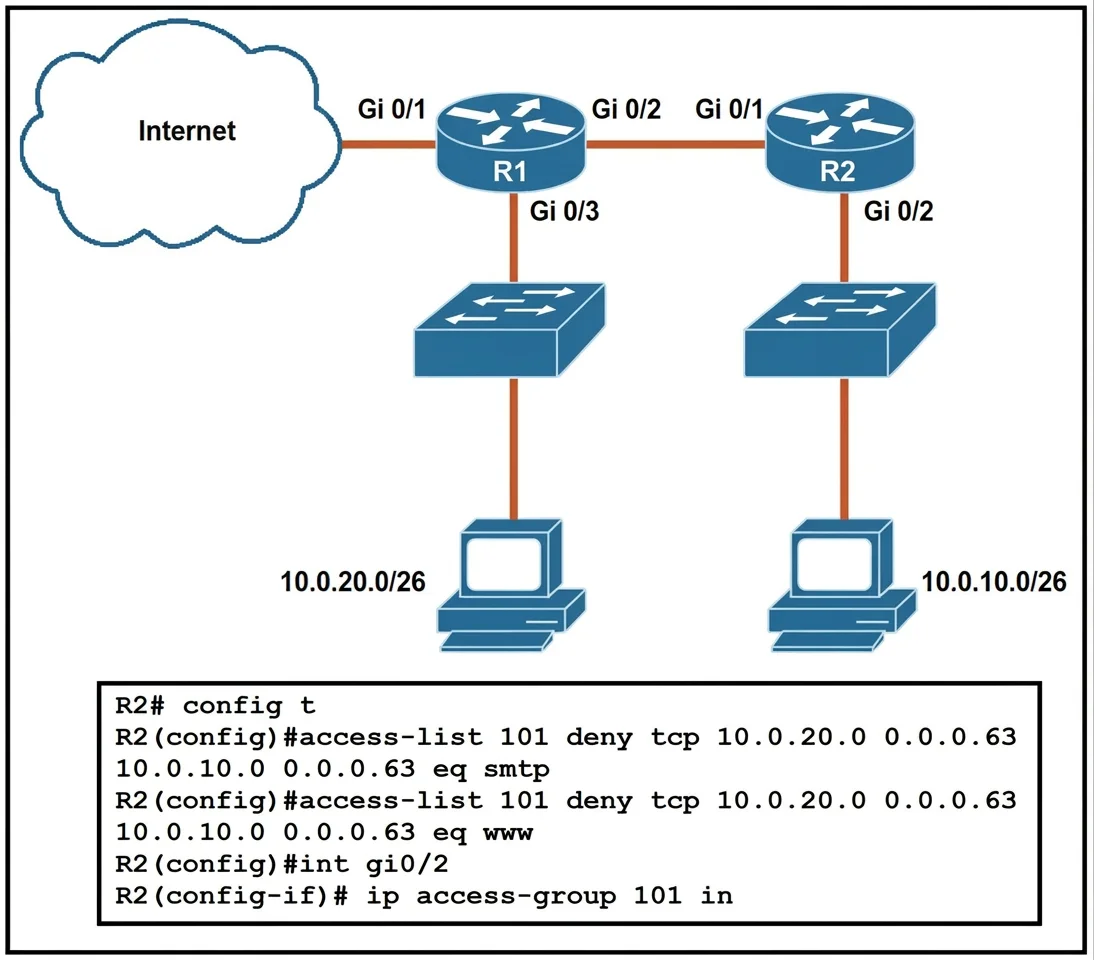
Refer to the exhibit. An extended ACL has been configured and applied to router R2. The configuration failed to work as intended. Which two changes stop outbound traffic on TCP ports 25 and 80 to…
The correct answer is B. Add a "permit ip any any" statement at the end of ACL 101 for allowed traffic C. The source and destination IPs must be swapped in ACL 101. Access Control Lists work top down. To allow all other traffic apart from what you configured as deny, you need to add a permit statement (permit any any) to the end of the ACL. ACLs are configured as source-destination. This shows destination-source so it needs to be Create an…
Question
Exhibits
Options
- AAdd a "permit ip any any" statement to the beginning of ACL 101 for allowed traffic.
- BAdd a "permit ip any any" statement at the end of ACL 101 for allowed traffic
- CThe source and destination IPs must be swapped in ACL 101
- DThe ACL must be configured the Gi0/2 interface in bound on R1
- EThe ACL must be moved to the Gi0/1interface outbound onR2
How the community answered
(35 responses)- A14% (5)
- B51% (18)
- D9% (3)
- E26% (9)
Explanation
Access Control Lists work top down. To allow all other traffic apart from what you configured as deny, you need to add a permit statement (permit any any) to the end of the ACL. ACLs are configured as source-destination. This shows destination-source so it needs to be Create an extended ACL: access-list [access-list-number] [dynamic dynamic-name] [timeout minutes]] {deny|permit} protocol source source-wildcard destination destination-wildcard [precedence precedence]
Topics
Community Discussion
No community discussion yet for this question.