
200-301 · Question #455
Drag and Drop Question Drag and drop the 802.11 wireless standards from the left onto the matching statements on the right. Answer:
The correct answer is 802.11n; 802.11g; 802.11ac; 802.11b; 802.11a. Important Note The question is incomplete as provided - the right-side statements (the descriptions to match against) are missing. Only the correct answer arrangement is shown, not what each position describes. Without those statements, I can't explain exactly why each standard…
Question
Exhibits
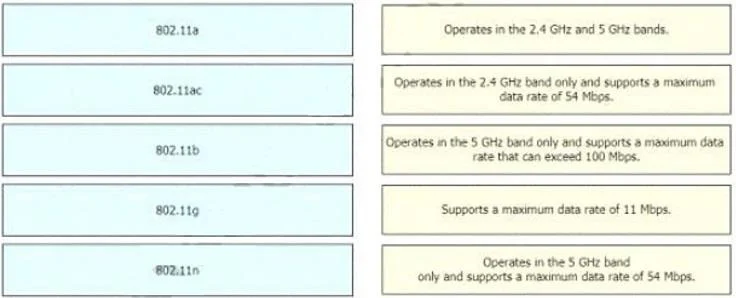
Answer Area
Drag items
Correct arrangement
- 802.11n
- 802.11g
- 802.11ac
- 802.11b
- 802.11a
Explanation
Important Note
The question is incomplete as provided - the right-side statements (the descriptions to match against) are missing. Only the correct answer arrangement is shown, not what each position describes. Without those statements, I can't explain exactly why each standard maps to each slot.
That said, here's a complete reference for all five standards so you can reason through any version of this question:
802.11 Standards Reference
| Standard | Frequency | Max Speed | Year | Key Trait |
|---|---|---|---|---|
| 802.11b | 2.4 GHz | 11 Mbps | 1999 | First widely adopted standard |
| 802.11a | 5 GHz | 54 Mbps | 1999 | Same era as b, but 5 GHz only |
| 802.11g | 2.4 GHz | 54 Mbps | 2003 | Faster b; backward compatible with b |
| 802.11n | 2.4 & 5 GHz | 600 Mbps | 2009 | First dual-band; introduced MIMO |
| 802.11ac | 5 GHz only | ~3.5 Gbps | 2013 | Fastest of these five; 5 GHz only |
Individual Placements (Based on Common Exam Statement Types)
Position 1 -> 802.11n: Likely identifies dual-band support (2.4 GHz + 5 GHz) or the introduction of MIMO. 802.11n is the only standard here that operates on both bands natively.
Position 2 -> 802.11g: Likely identifies 2.4 GHz with 54 Mbps and backward compatibility with 802.11b. This distinguishes it from 802.11a (which is also 54 Mbps but on 5 GHz).
Position 3 -> 802.11ac: Likely identifies the highest throughput (gigabit-class speeds) or 5 GHz-only with MU-MIMO/beamforming.
Position 4 -> 802.11b: Likely identifies the lowest max speed (11 Mbps) or the first mass-market Wi-Fi standard at 2.4 GHz.
Position 5 -> 802.11a: Likely identifies 5 GHz + 54 Mbps - same speed as g, but 5 GHz-only and not backward compatible with b/g.
Common Mistakes
- Confusing a and g: Both are 54 Mbps, but
ais 5 GHz andgis 2.4 GHz. Exam questions often exploit this. - Forgetting n is dual-band: Students often assign n only to 5 GHz - it supports both.
- Speed ordering: b (11) -> a/g (54) -> n (600) -> ac (3500+).
aandghave the same max speed despite different frequencies. - Chronological vs. alphabetical: The letter order (a, b, g, n, ac) does not match release order for real-world deployment -
bcame first commercially despiteabeing technically simultaneous.
If you can share the actual right-side statements, I can give you a precise explanation for each mapping.
Topics
Community Discussion
No community discussion yet for this question.