
200-301 · Question #1776
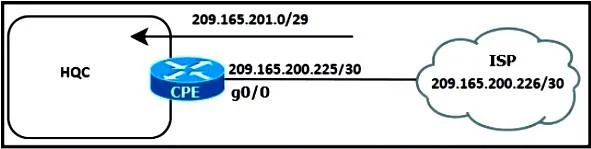
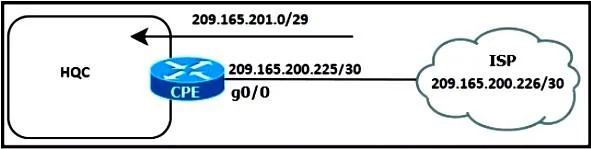
Refer to the exhibit. HQC needs to use a configuration that: - handles up to 150,000 concurrent connections - minimizes consumption of public IP addresses Which configuration meets the requirements?
The correct answer is D. ip nat pool NATPOOL 209.165.201.1 209.165.201.3 netmask 255.255.255.248. HQC must support 150,000 concurrent connections with minimal public IP usage. Each public IPv4 address used for PAT (NAT overload) can handle about 64,000 source ports. A pool of three public IPs (209.165.201.1–209.165.201.3) provides roughly 3 × 64,000 ≈ 192,000 connections…
Question
Refer to the exhibit. HQC needs to use a configuration that:
- handles up to 150,000 concurrent connections
- minimizes consumption of public IP addresses
Which configuration meets the requirements?
Exhibits
Options
- Aip nat pool NATPOOL 209.165.201.1 209.165.201.5 netmask 255.255.255.248
- Bip nat pool NATPOOL 209.165.201.1 209.165.201.248 netmask 255.255.255.248
- Cip nat pool NATPOOL 209.165.200.225 209.165.200.226 netmask 255.255.255.252
- Dip nat pool NATPOOL 209.165.201.1 209.165.201.3 netmask 255.255.255.248
How the community answered
(18 responses)- A11% (2)
- B6% (1)
- C6% (1)
- D78% (14)
Explanation
HQC must support 150,000 concurrent connections with minimal public IP usage. Each public IPv4 address used for PAT (NAT overload) can handle about 64,000 source ports. A pool of three public IPs (209.165.201.1–209.165.201.3) provides roughly 3 × 64,000 ≈ 192,000 connections, satisfying the 150,000 requirement while using the fewest addresses. Configuration D correctly defines an inside NAT pool from the 209.165.201.0/29 block and applies ip nat inside source ... overload to perform PAT for inside hosts.
Topics
Community Discussion
No community discussion yet for this question.