
200-301 · Question #1762
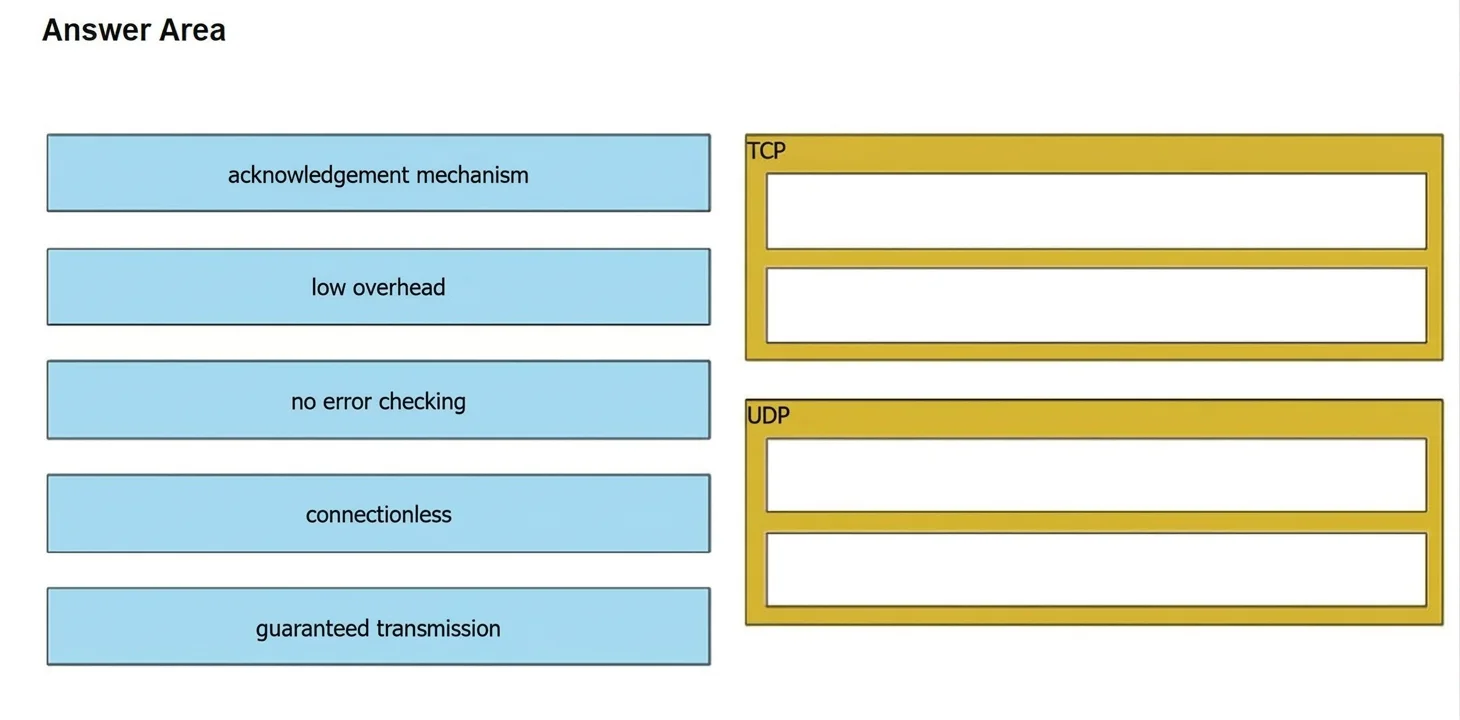
Drag and Drop Question Drag and drop the protocol characteristics from the left onto the corresponding types on the right. Not all characteristics are used. Answer:
The correct answer is acknowledgement mechanism; guaranteed transmission; low overhead; no error checking; connectionless. The correct arrangement maps TCP characteristics (acknowledgement mechanism, guaranteed transmission) and UDP characteristics (low overhead, no error checking, connectionless) to their respective protocol types. TCP is a connection-oriented protocol that ensures reliable…
Question
Exhibit
Answer Area
Drag items
Correct arrangement
- acknowledgement mechanism
- guaranteed transmission
- low overhead
- no error checking
- connectionless
Explanation
The correct arrangement maps TCP characteristics (acknowledgement mechanism, guaranteed transmission) and UDP characteristics (low overhead, no error checking, connectionless) to their respective protocol types. TCP is a connection-oriented protocol that ensures reliable delivery through acknowledgements and guaranteed transmission, while UDP is a lightweight, connectionless protocol that sacrifices reliability for speed by omitting error checking and connection establishment overhead.
Topics
Community Discussion
No community discussion yet for this question.