
200-301 · Question #1701
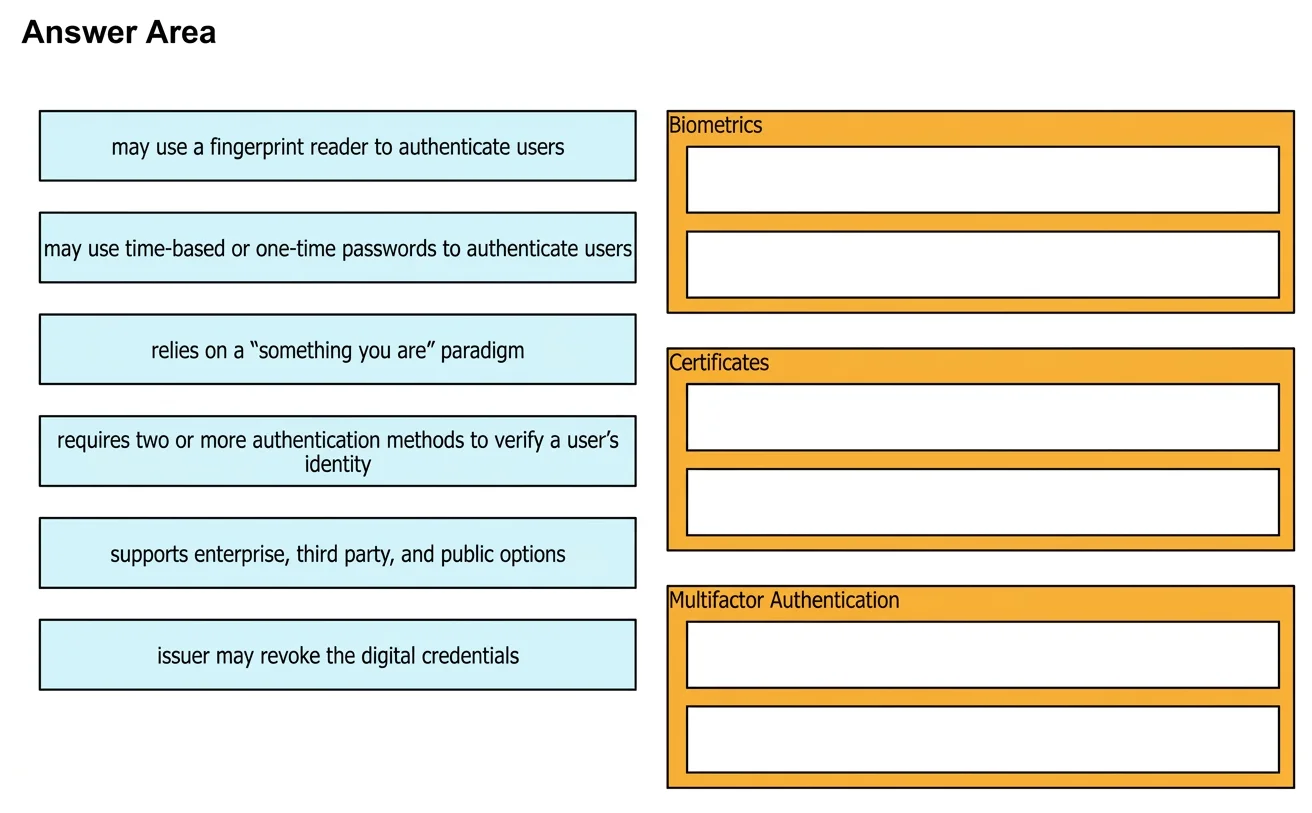
Drag and Drop Question Drag and drop the descriptions of security features from the left onto the corresponding features on the right. Answer:
The correct answer is may use a fingerprint reader to authenticate users; relies on a "something you are" paradigm; supports enterprise, third party, and public options; issuer may revoke the digital credentials; may use time-based or one-time passwords to authenticate users; requires two or more authentication methods to verify a user's identity. The correct arrangement matches each description to its corresponding security feature based on core principles: Biometrics uses physical characteristics like fingerprints ('something you are' paradigm), MFA requires two or more authentication methods, digital certificates…
Question
Exhibit
Answer Area
Drag items
Correct arrangement
- may use a fingerprint reader to authenticate users
- relies on a "something you are" paradigm
- supports enterprise, third party, and public options
- issuer may revoke the digital credentials
- may use time-based or one-time passwords to authenticate users
- requires two or more authentication methods to verify a user's identity
Explanation
The correct arrangement matches each description to its corresponding security feature based on core principles: Biometrics uses physical characteristics like fingerprints ('something you are' paradigm), MFA requires two or more authentication methods, digital certificates support enterprise/third-party/public options (e.g., private CA, third-party CA, public CA) and can be revoked by the issuer, and MFA/OTP systems use time-based or one-time passwords. Each feature has distinct characteristics that align with specific authentication paradigms and trust models defined in security frameworks.
Topics
Community Discussion
No community discussion yet for this question.