
200-301 · Question #1664
Lab Simulation 51 Please use the "Tasks" and "Topology" tabs to complete this lablet. Topology Tasks Refer to the topology. All physical cabling is in place. Routers 1 and 3 are accessible…
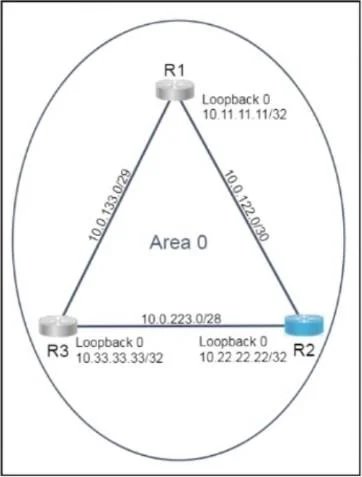
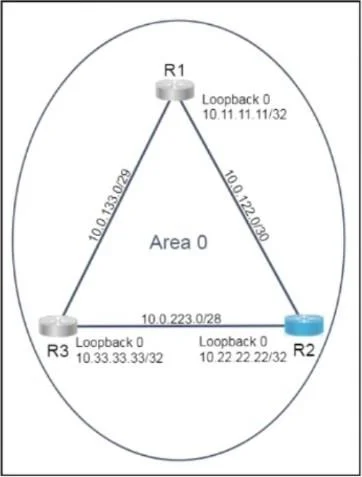
This lab simulation requires configuring OSPF on router R2, including specific process ID, router ID, network advertisements with correct wildcard masks, and disabling R2's participation in DR/BDR elections on its connected interfaces within Area 0.
Question
Exhibits
Explanation
This lab simulation requires configuring OSPF on router R2, including specific process ID, router ID, network advertisements with correct wildcard masks, and disabling R2's participation in DR/BDR elections on its connected interfaces within Area 0.
Approach. The correct interaction would involve accessing the command-line interface (CLI) of Router 2 (R2) in the simulation environment and executing the following configuration commands, assuming a Cisco IOS-like syntax:
-
Enter global configuration mode:
configure terminal -
Start OSPF process with ID 122:
router ospf 122 -
Set the OSPF Router ID to R2's Loopback 0 IP:
router-id 10.22.22.22 -
Advertise R2's connected networks into Area 0 using inverted (wildcard) masks:
- Loopback 0 (10.22.22.22/32): The wildcard mask for a /32 is 0.0.0.0.
network 10.22.22.22 0.0.0.0 area 0 - Link to R1 (10.0.122.0/30): The wildcard mask for a /30 is 0.0.0.3.
network 10.0.122.0 0.0.0.3 area 0 - Link to R3 (10.0.223.0/28): The wildcard mask for a /28 is 0.0.0.15.
network 10.0.223.0 0.0.0.15 area 0
- Loopback 0 (10.22.22.22/32): The wildcard mask for a /32 is 0.0.0.0.
-
Exit OSPF configuration mode:
exit -
Configure R2's physical interfaces connected to R1 and R3 to not participate in DR/BDR elections:
- This is achieved by setting the OSPF priority to 0 on those specific interfaces. (In a real lab, you would identify the correct interface names, e.g., using
show ip interface briefor referring to the topology's implied interface connections. For this explanation, we'll assumeGigabitEthernet0/1connects to R1 andGigabitEthernet0/2connects to R3.)interface GigabitEthernet0/1ip ospf priority 0exitinterface GigabitEthernet0/2ip ospf priority 0exit
- This is achieved by setting the OSPF priority to 0 on those specific interfaces. (In a real lab, you would identify the correct interface names, e.g., using
This sequence of commands correctly addresses all requirements: OSPF process ID, router ID, network advertisement with exact prefixes using wildcard masks, placement in Area 0, and ensuring R2 does not participate in DR/BDR elections by setting the OSPF priority to 0 on its relevant interfaces.
Common mistakes.
- common_mistake. Common mistakes for this type of question include:
- Incorrect OSPF process ID: Using any number other than 122 for the
router ospfcommand. - Incorrect Router ID: Not explicitly setting
router-id 10.22.22.22or choosing an incorrect IP address for the router ID. - Incorrect Wildcard Masks: Failing to calculate and use the correct inverted subnet (wildcard) mask for each network statement (e.g., using
0.0.0.255instead of the precise0.0.0.3or0.0.0.15). - Missing Network Advertisements: Not advertising all connected OSPF-enabled networks, especially the loopback interface (crucial for router ID stability and reachability) or one of the physical links.
- Incorrect Area Assignment: Placing networks in an OSPF area other than
area 0. - Failing to disable DR/BDR participation: Not configuring
ip ospf priority 0on the specific physical interfaces of R2 connected to R1 and R3. Simply not configuring an interface for OSPF would prevent neighbor adjacency entirely, which is not the goal. While changing the OSPF network type to point-to-point could also avoid DR/BDR elections,priority 0is the direct and most robust method to ensure non-participation on a multi-access segment while maintaining adjacency. - Applying
ip ospf priority 0to the loopback interface: Loopback interfaces, by OSPF design, typically operate as point-to-point network types and do not participate in DR/BDR elections, making this configuration redundant and incorrect for the specified task.
Concept tested. The core technical concepts tested are OSPF fundamentals, including configuring OSPF processes, manually setting the OSPF Router ID, advertising networks using the network command with correct wildcard masks, understanding OSPF areas, and controlling the OSPF Designated Router (DR) and Backup Designated Router (BDR) election process by manipulating OSPF interface priorities.
Topics
Community Discussion
No community discussion yet for this question.