
200-301 · Question #1586
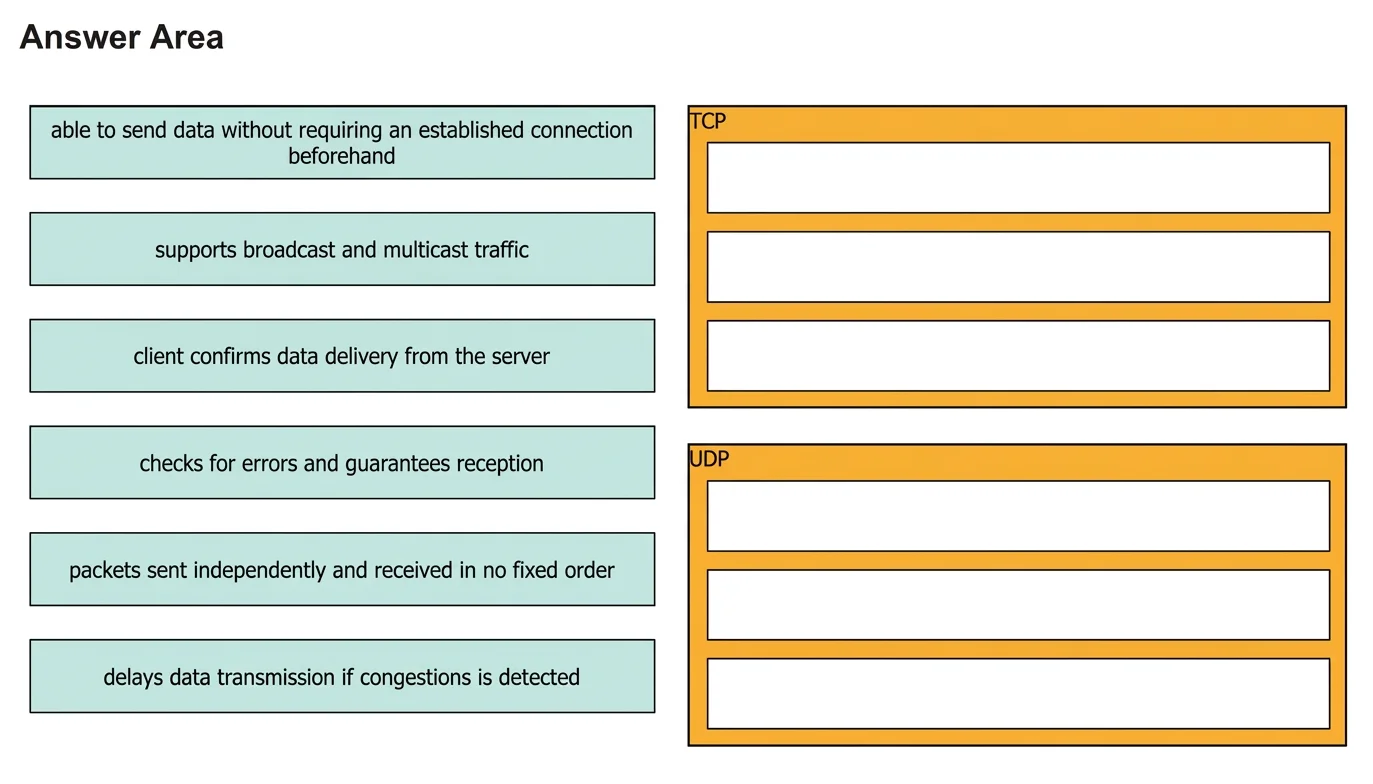
Drag and Drop Question Drag and drop the transport layer requirements for a new network deployment from the left onto the corresponding transport layer protocols that support them on the right…
The correct answer is client confirms data delivery from the server; checks for errors and guarantees reception; delays data transmission if congestions is detected; able to send data without requiring an established connection beforehand; supports broadcast and multicast traffic; packets sent independently and received in no fixed order. TCP (Transmission Control Protocol) is a connection-oriented protocol that requires a three-way handshake before data transfer, guarantees reliable delivery through acknowledgments (client confirms data delivery), performs error checking, and uses congestion control mechanisms…
Question
Exhibit
Answer Area
Drag items
Correct arrangement
- client confirms data delivery from the server
- checks for errors and guarantees reception
- delays data transmission if congestions is detected
- able to send data without requiring an established connection beforehand
- supports broadcast and multicast traffic
- packets sent independently and received in no fixed order
Explanation
TCP (Transmission Control Protocol) is a connection-oriented protocol that requires a three-way handshake before data transfer, guarantees reliable delivery through acknowledgments (client confirms data delivery), performs error checking, and uses congestion control mechanisms to delay transmission when network congestion is detected. UDP (User Datagram Protocol) is connectionless, meaning it can send data without establishing a connection beforehand, supports broadcast and multicast traffic, and sends packets independently without guaranteeing order or reliable delivery - making it lightweight but unreliable.
Topics
Community Discussion
No community discussion yet for this question.